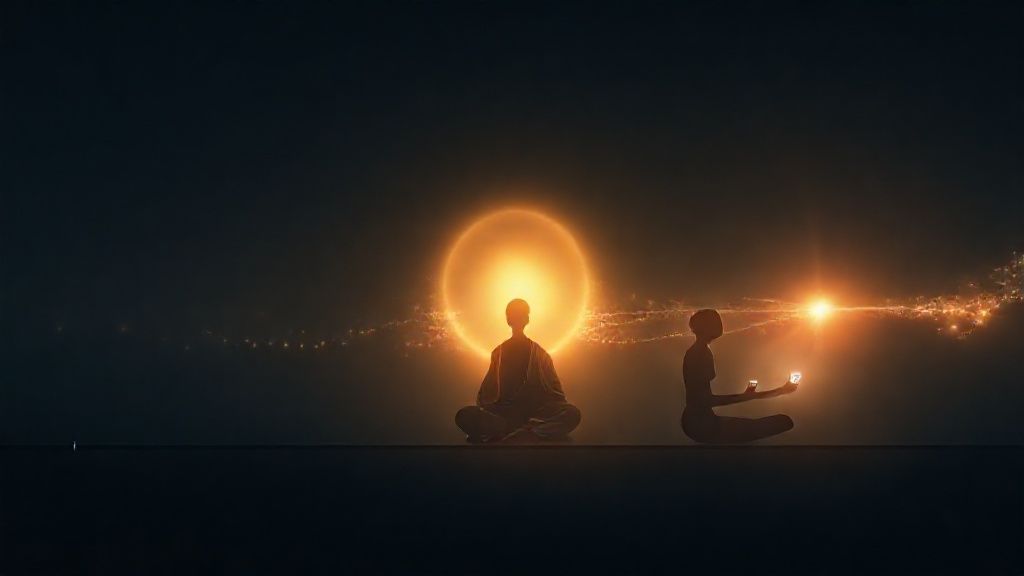
冥想的历史:源自古籍的现代实践
In our fast-paced, hyper-connected world, it’s not uncommon to feel overwhelmed. The constant ping of notifications, the pressure to perform, and the endless to-do lists leave many of us searching for an anchor. It’s no surprise that millions are turning to meditation, seeking a sliver of silence in the noise. But this practice is far from a modern-day fad or a Silicon Valley biohack. The story of meditation is a profound human narrative, stretching back thousands of years and woven through the spiritual fabric of countless cultures.
Meditation is an ancient practice with roots tracing back to the dawn of civilization across multiple continents. What began as a deeply religious discipline aimed at enlightenment and transcendence has evolved into a mainstream, scientifically-backed tool for mental and physical well-being. This guide will take you on a journey through time, from the earliest whispers of contemplative practice in ancient India to the digital apps on your phone, exploring the key figures and cultural shifts that transformed meditation into the global phenomenon it is today.
The Ancient Origins: Where Did Meditation Begin?
The quest to understand the mind and consciousness is as old as humanity itself. Long before meditation became a wellness trend, it was a sacred path to understanding the nature of reality.
Early Traces in Hindu Traditions
The earliest documented references to meditation come from the Indian subcontinent, found in the ancient Hindu scriptures known as the Vedas, dating back to around 1500 BCE. The practices described in these texts, particularly in the later Tantric and Vedantic traditions, were designed to help practitioners understand the deep connection between their inner self (Atman) and the universal reality (Brahman).
Central to these early practices was the concept of “Dhyana,” a Sanskrit term that refers to a state of profound meditation and contemplation. Dhyana was the seventh limb of the eightfold path of Yoga, as outlined by the sage Patanjali in the Yoga Sutras. The goal was not merely relaxation but to train the mind to transcend its constant chatter and perceive a higher state of consciousness. This foundational concept would later travel to China and become known as “Chan,” and to Japan as “Zen.”
The Buddhist Evolution
While meditation existed in the Hindu tradition, it was Siddhartha Gautama, later known as the 佛陀 (circa 500 BCE), who refined and systematized the practice, making it the very core of his teachings. After attaining enlightenment under the Bodhi tree through intense meditation, the Buddha dedicated his life to teaching others the path to liberation from suffering (Dukkha).
The Buddhist tradition developed and codified various meditation techniques, most notably differentiating between two primary forms:
* Vipassana (Insight Meditation): This practice focuses on seeing things as they truly are, through moment-to-moment awareness of sensations and thoughts. It cultivates clarity and understanding of the impermanent nature of reality.
* Samatha (Calm-Abiding Meditation): This technique aims to develop concentration, tranquility, and one-pointedness of mind, often by focusing on the breath or a specific object.
These structured paths made the profound benefits of meditation accessible to a broader audience, setting the stage for its spread across Asia. If you’re intrigued by this ancient technique, you can learn the principles of Vipassana meditation online.

Meditation’s Journey Along the Silk Road
As trade routes connected the East, so too did they carry ideas. Meditation began a centuries-long migration, adapting and transforming with each new culture it touched.
Adaptation in Taoist and Confucian China
When Buddhism traveled from India to China around the 1st century CE, it encountered rich indigenous philosophical traditions like Taoism and Confucianism. This fusion was transformative. Taoist concepts of naturalness, spontaneity, and working with the body’s energy (Qi) blended seamlessly with Buddhist meditation. This synthesis gave rise to energy-based practices like Qigong 及 Neigong, which integrated movement, breath control, and meditation to cultivate and balance life force.
Integration and Refinement in Japan
From China, the Chan school of Buddhism crossed into Japan, where it became known as Zen. Japanese culture, with its emphasis on discipline, simplicity, and direct experience, further refined the practice. The core of Zen meditation is Zazen—literally “seated meditation.” In Zazen, practitioners sit in a specific posture, often facing a wall, and focus on breath observation while letting thoughts arise and pass without attachment. This stark, no-nonsense approach emphasized experiential wisdom over scriptural study, a characteristic that would later appeal greatly to the Western mind.
Meditation in the Western World
For centuries, meditation remained largely an Eastern practice in the Western imagination. Its journey to the West was a slow burn that eventually ignited into a cultural explosion.
The First Wave: 18th & 19th Century Translations
The initial introduction came through scholars, philosophers, and translators. In the late 18th and 19th centuries, figures like Arthur Schopenhauer were deeply influenced by translations of the Upanishads. The Theosophical Society, founded in 1875, also played a crucial role in popularizing Eastern spiritual concepts, including meditation, among intellectuals and spiritual seekers in Europe and America.
The 20th Century Boom: Science Meets Spirituality
The real tipping point came in the mid-20th century, propelled by a perfect storm of social and scientific factors.
-
The Counterculture Movement: The 1960s and 70s saw a generation disillusioned with traditional Western values. They looked to the East for alternative spiritual models, and figures like the Beatles studying with Maharishi Mahesh Yogi brought Transcendental Meditation (TM) into the global spotlight. TM offered a simple, mantra-based technique that didn’t require a change in lifestyle or belief system, making it immensely popular. To understand this influential method, you can explore the foundations of Transcendental Meditation.
-
The Secularization of Mindfulness: Perhaps the most pivotal moment for meditation’s integration into Western society was the work of Dr. Jon Kabat-Zinn. In 1979, he developed the 正念减压疗法 program at the University of Massachusetts Medical School. Kabat-Zinn’s genius was in systematically stripping Buddhist meditation of its religious framework, presenting it as a rigorous, scientific method for managing pain, stress, and illness. The success of MBSR opened the floodgates for clinical research and legitimized meditation in the eyes of doctors, scientists, and the general public. For those interested in this clinical approach, you can 了解现代正念减压训练课程.

科学时代:冥想如何征服主流文化
在世俗基础奠定之后,二十世纪末至二十一世纪初,在科学与技术两股强大力量的推动下,冥想向主流文化展开了全面冲击。.
世俗正念的兴起
正念减压课程在神经科学和心理学领域引发了一场革命。利用功能性磁共振成像和脑电图技术,研究者们开始量化冥想者数千年来已知的体验。研究表明,冥想能够:
* 降低大脑 “默认模式网络”(负责神游与自我指涉思维)的活动。.
* 增厚前额叶皮层, ,该区域与觉察、专注和决策等高级脑功能相关。.
* 缩小杏仁核, ——大脑的恐惧中枢,从而降低压力与焦虑反应。.
这种科学验证将冥想从一种“灵性修习”转变为一种基于证据的 “心智训练” 工具。它开始被治疗师推荐,并在学校、企业和运动队中实施。如果您正感到不堪重负,可以 探索针对焦虑的特定冥想练习.
数字革命:应用程序与在线普及
最后的入门障碍——可及性——被智能手机彻底消除。2010年代初期, Headspace 及 Calm 等应用程序的推出,将冥想导师送到了每个人的口袋中。这些平台为各种可想到的场景——通勤、工作、睡眠——提供简短、有指导的练习课程,使得初学者也能轻松入门。这种数字化的普及已将冥想带给全球数千万用户。要找到适合您的工具,, 可比较诸如Headspace等热门冥想应用.

您的冥想之旅:在今日运用古老智慧
了解这段丰富的历史固然引人入胜,但冥想的真正价值在于您将其化为己用。这项修习的整个演变历程都指向此刻——您能够以前所未有的便捷方式触及这份古老智慧。.
在现代世界中找到您的修习方式
您无需退隐到喜马拉雅山洞穴或成为佛教僧侣也能从冥想中获益。其演变之美在于,如今已有适合每种性格与生活方式的修习形式。无论您是被禅宗的静默、内观的分析性、气功的动感,还是现代应用程序的引导式方法所吸引,大门已然敞开。关键在于开始。为了正确起步,, 可从最适合初学者的引导冥想开始.
适用于每一刻的练习
古代圣贤或许会冥想数小时,但现代生活往往需要更务实的方法。即使时间短暂,其核心原则依然不变。不妨参考这些古老技巧的现代应用:
- 晨间惯例: 用一次简短的专注呼吸练习为一天定下积极的基调。 一段5分钟晨间冥想.
- 日间减压: 通过三分钟的正念呼吸练习,在片刻间重置您的神经系统。 在办公桌前进行1分钟快速呼吸练习.
- 针对睡眠: 通过一次引导式睡眠冥想,让身心深度休息与修复,促进疗愈。 关于冥想历史的常见问题.
最古老的冥想形式是什么?
有记载的最古老冥想形式被认为是古印度的吠陀和萨满实践。最早的书面记录可追溯至约公元前1500年的印度教吠陀经文,其中描述了旨在超越人类境况的冥想技巧。然而,很可能在某些史前文化中,某种形式的沉思或诱导出神状态的实践甚至早于这些记录。
冥想是一种宗教修习吗?.
冥想起源于宗教和灵性传统,包括印度教、佛教、道教和基督教(如默观祈祷)。然而,在上个世纪,它已在很大程度上被世俗化。诸如正念减压之类的练习完全专注于其经过验证的心理和生理益处——如减轻压力、提升专注力——而不包含任何宗教或灵性成分。您完全可以将冥想作为一种心智训练形式来实践,无需信奉任何信仰。要了解纯粹的实际应用,
可了解更多关于世俗引导冥想的信息。, 过去100年来冥想发生了哪些变化?.
过去一个世纪见证了冥想历史上最剧烈的转变。它已从一种深奥的、 primarily 宗教性的修行,转变为主流的、经科学验证的健康与效能工具。主要变化包括:
世俗化:
1. 核心技巧从其宗教背景中分离出来。 科学验证:.
2. 神经科学和心理学已证明其对大脑和身体的益处。 普及化:.
3. 从书籍到应用程序的技术,使其在任何地方对任何人都触手可及。 多样化:.
4. 无数新的风格和应用已经出现,从企业健康到运动训练。要了解现代可及性的一个典型例子, 可探索现代冥想视频。, 冥想的历史是一幅丰富而广阔的织锦,交织着古老智慧、跨文化交流和革命性科学的丝线。从印度森林中的圣贤,到硅谷开发下一代冥想应用程序的程序员,人类对内心平静的追求始终如一。这段历程表明,冥想并非一件静态的遗物,而是一种鲜活的、不断演变的修习,它适应并满足每一代人的需求。.
总结与行动号召
您现在也是这个故事的一部分。通过练习冥想,您正在参与一项数千年的人类传统——向内观照以培养澄明、慈悲与平静。历史固然迷人,但益处却在当下体验。.
从今天开始书写您自己的冥想历史。.
现在就从一次简单的5分钟冥想开始,. 体验那回荡了数千年的平静。 您的10分钟Headspace冥想:寻找平静的初学者指南.