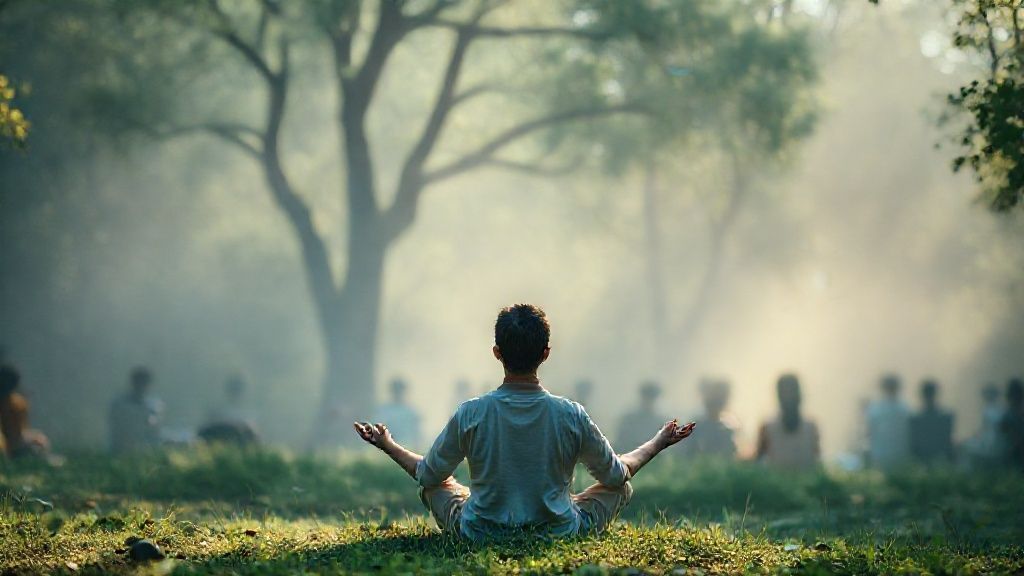
社交焦虑冥想指南:通往平静与自信的实用手册 - 生活
That moment when your heart starts racing as you walk into a room full of people. The dread that builds before a presentation, the panic that surfaces during a team meeting, the overwhelming self-consciousness that makes simple conversations feel like monumental challenges. If this sounds familiar, you’re not alone—and more importantly, you’re not without solutions.
Meditation for social anxiety isn’t just a wellness trend; it’s a powerful, evidence-based tool that can fundamentally rewire your brain’s response to social stress and fear. While social anxiety disorder affects approximately 7% of the population at any given time, many more experience subclinical social anxiety that significantly impacts their quality of life. The good news? Research consistently shows that meditation can create measurable changes in how your brain processes social threats.
Here’s the key insight: Meditation for social anxiety works by calming the amygdala, the brain’s fear center, and strengthening the prefrontal cortex, which regulates emotional responses. This guide provides actionable techniques you can start today to transform your relationship with social situations.
Understanding Social Anxiety and How Meditation Helps
Social anxiety disorder extends far beyond simple shyness or occasional nervousness. It’s characterized by intense, persistent fear of being watched, judged, or embarrassed in social situations. This fear can be so overwhelming that it interferes with work, school, relationships, and daily activities.
When facing social situations, the brain’s “fight-or-flight” response activates unnecessarily. Your amygdala—the part of your brain responsible for detecting threats—sounds the alarm, flooding your body with stress hormones like cortisol and adrenaline. This evolutionary survival mechanism, while helpful when facing actual danger, becomes problematic when triggered by everyday social interactions.
This is where meditation creates transformative change. Neuroscience research reveals that consistent meditation practice:
- Reduces amygdala activity: Regular meditators show decreased activation in the brain’s fear center when exposed to stressful stimuli
- Strengthens prefrontal cortex: Meditation increases gray matter density in areas responsible for emotional regulation and self-awareness
- Enhances connectivity: It improves communication between the prefrontal cortex and amygdala, allowing for better emotional control
These neurological changes translate to very real benefits: less reactivity in social situations, improved ability to stay present during conversations, and reduced anticipatory anxiety about social events.
If you’re looking to build foundational skills for managing anxiety more broadly, our comprehensive guide to – 培养接纳与平和 offers additional techniques and insights.
Getting Started: Your First Meditation for Social Anxiety
Beginning a meditation practice can feel daunting, especially when you’re already dealing with anxiety. The most important principle to remember is that meditation is a practice, not a performance. There’s no such thing as “doing it wrong” as long as you’re making the effort to show up for yourself.
创建你的冥想空间: While you can meditate anywhere, having a dedicated, quiet space can help establish consistency. This doesn’t need to be elaborate—a comfortable chair or cushion in a relatively quiet corner is sufficient. The goal is to create an environment where you feel safe and won’t be interrupted for the duration of your practice.
A Simple Breathing Technique for Instant Calm
When social anxiety strikes, your breath is your most accessible tool. The 4-7-8 breathing technique is particularly effective for quickly calming your nervous system:
- 通过鼻子缓慢吸气 quietly through your nose for 4 counts
- Hold your breath for 7 counts
- 通过嘴巴缓慢呼气 completely through your mouth for 8 counts, making a whooshing sound
- Repeat this cycle 3-4 times
This pattern activates the parasympathetic nervous system, which counteracts the fight-or-flight response. The extended exhalation is particularly calming, signaling to your body that there’s no immediate danger.

When you need immediate relief in social situations, our 一分钟呼吸练习 offers a quick, discreet way to reset your nervous system.
身体扫描:重新连接身体感觉
Social anxiety often pulls us into catastrophic thinking about the future (“What if I embarrass myself?”) or ruminating about the past (“I shouldn’t have said that”). The body scan meditation helps anchor your awareness in the present moment by systematically moving attention through different parts of your body.
A basic body scan practice:
1. Lie down or sit comfortably with your back straight
2. Bring your attention to the sensations in your feet
3. Slowly move your awareness up through your ankles, calves, knees, and thighs
4. Continue scanning upward through your torso, hands, arms, shoulders, neck, and head
5. Notice sensations without judgment—tingling, warmth, tension, or numbness are all equally valid
6. If your mind wanders, gently guide it back to the body part you were scanning
This practice is powerful for social anxiety because it trains you to notice physical sensations (like a racing heart or tense shoulders) without immediately interpreting them as threats. Instead of “My heart is racing, I must be panicking,” you learn to observe “There’s a fluttering sensation in my chest.”
For a structured approach to this practice, you can download our free 5-minute body scan script to guide your early sessions.
Core Meditation Techniques for Social Anxiety
While any meditation practice can benefit overall wellbeing, certain techniques are particularly well-suited to addressing the specific challenges of social anxiety.
Mindfulness Meditation: Observing Without Judgment
Mindfulness meditation forms the foundation of most modern therapeutic approaches to anxiety. The practice involves intentionally paying attention to the present moment without judgment.
How to practice mindfulness meditation for social anxiety:
- 1. 舒适地坐下,背部挺直但不要僵硬
- Bring your attention to your breath, noticing the sensation of air moving in and out
- When thoughts, emotions, or bodily sensations arise, simply notice them without engaging
- Label them if helpful (“thinking,” “worrying,” “planning”)
- Gently return your attention to the breath
The revolutionary aspect of this practice for social anxiety is that it creates space between you and your anxious thoughts. Instead of being caught in the story your anxiety is telling (“Everyone will think I’m boring”), you learn to observe the thought as a passing mental event. This doesn’t eliminate anxious thoughts, but it dramatically reduces their power over you.
Loving-Kindness (Metta) Meditation: Cultivating Self-Compassion
Social anxiety is often fueled by harsh self-criticism and fear of negative evaluation. Loving-kindness meditation directly counters this pattern by systematically developing feelings of kindness and compassion toward yourself and others.
The traditional loving-kindness sequence:
- Begin by directing kind wishes toward yourself: “May I be happy. May I be healthy. May I be safe. May I live with ease.”
- Next, bring to mind someone you feel naturally grateful for or affectionate toward, directing the same wishes to them
- Bring to mind a neutral person (someone you see regularly but have no strong feelings about)
- If you feel ready, bring to mind someone with whom you have difficulty
- Finally, extend these wishes to all beings everywhere
This practice is particularly transformative for social anxiety because it directly addresses the core fear of social rejection while building self-compassion. Research shows that regular loving-kindness meditation can increase positive emotions and social connectedness while decreasing self-criticism.

To guide you through this powerful practice, we’ve created a detailed 慈爱冥想引导语 that you can follow step by step.
Grounding Meditation: Anchoring in the Present Moment
During moments of intense social anxiety, your thoughts might race while your body feels disconnected or overwhelmed. Grounding meditation uses your five senses to anchor you firmly in the present moment, interrupting the cycle of anxious thoughts.
The 5-4-3-2-1 grounding technique:
- Notice 5 things you can see: Look around and name five things you can see, from large objects to small details
- Notice 4 things you can feel: Pay attention to four physical sensations (your feet on the floor, the texture of your clothing, the temperature of the air)
- Notice 3 things you can hear: Listen carefully to three distinct sounds in your environment
- Notice 2 things you can smell: Identify two scents around you (or recall two favorite smells)
- Notice 1 thing you can taste: Notice the taste in your mouth or taste something small
This technique works because it forces your brain to shift from internal catastrophizing to external observation. It’s particularly useful in social situations where you might feel overwhelmed but need to remain present.
For situations where you need quick relief, our two-minute grounding meditation script provides a structured approach you can use anywhere.
建立可持续的冥想习惯
The benefits of meditation for social anxiety accumulate through consistent practice rather than perfect sessions. When establishing your practice, prioritize consistency over duration. Research suggests that just 5-10 minutes of daily meditation can create significant changes in brain structure and function over 8 weeks.
Tips for building a sustainable habit:
- 从小处开始: Begin with just 5 minutes daily rather than aiming for 30 minutes and becoming discouraged
- Anchor to existing habits: Practice meditation after an established routine like brushing your teeth or having your morning coffee
- Be compassionate: Missed days are part of the process, not failure. Gently return to your practice without self-criticism
- 记录进展轨迹: Use a simple calendar or meditation app to build momentum through visible streaks
Short & Effective Meditation Sessions
For managing social anxiety, brief but regular meditation sessions are often more effective than occasional long sessions. The goal is to train your brain to return to a calm, present state more readily—a skill that becomes increasingly accessible with repetition.

When time is limited, our 5-minute meditation for anxiety provides a focused practice that fits into even the busiest schedule. For slightly longer sessions, our 10分钟焦虑引导冥想 offers more comprehensive guidance while remaining accessible for daily practice.
Enhancing Your Practice With Supporting Resources
While self-guided meditation is powerful, additional resources can deepen your practice and provide variety, which helps maintain engagement over time.
Guided Meditations for Deeper Work
Once you’ve established a consistent practice, longer guided meditations can help you work more deeply with patterns of social anxiety. These extended sessions allow for more thorough exploration of bodily sensations, thought patterns, and emotional responses.
For those times when you can dedicate more time to your practice, our 20分钟焦虑与过度思考引导冥想 provides a comprehensive approach to working with the mental patterns that fuel social anxiety.
Using Meditation Apps and Tools
Meditation apps can provide structure, variety, and guidance, especially when you’re establishing your practice. Many offer specific programs for anxiety, social anxiety, and building confidence in social situations.
These tools can be particularly helpful for maintaining consistency when traveling or during busy periods when your routine might be disrupted. If you’re curious about digital options, our guide to 如Headspace等热门冥想应用 冥想应用程序指南.
Meditation for Sleep and Anxiety
Social anxiety often disrupts sleep, as the mind replays social interactions or worries about upcoming events. Since poor sleep exacerbates anxiety, creating a positive feedback loop, establishing good sleep habits is crucial for managing social anxiety.
Meditation before bed can calm the nervous system and quiet mental chatter, leading to more restorative sleep. Our guided sleep meditation for anxiety is specifically designed to help you transition from wakefulness to sleep while addressing the anxious thoughts that often surface at night.
的评测文章
How Long Does It Take for Meditation to Help With Social Anxiety?
Many people notice a calming effect immediately after a single meditation session, but lasting neurological changes typically take approximately 8 weeks of consistent daily practice. Think of meditation as exercise for your brain—while you might feel better after one workout, significant transformation requires regular practice over time. The key is consistency rather than perfection.
Can Meditation Replace Therapy for Social Anxiety?
Meditation is a powerful complementary tool, but for diagnosed social anxiety disorder, it should typically be used alongside professional therapy like Cognitive Behavioral Therapy (CBT). While meditation can significantly reduce symptoms and build resilience, therapy addresses the underlying cognitive patterns and provides specific behavioral strategies for social situations. If you’re interested in understanding the full range of treatment options, you might explore 练习,而非专业医疗或心理护理的替代品。如果你正在应对临床焦虑症,咨询医生或心理健康专业人士至关重要。冥想可以与 to make an informed decision about your care.
冥想时思绪无法停止怎么办?
This is one of the most common concerns among new meditators, especially those with anxiety. The goal of meditation isn’t to stop thoughts but to change your relationship with them. When you notice your mind has wandered, the simple act of gently returning your attention to your anchor (like the breath) is the practice itself. Each time you do this, you’re strengthening your ability to disengage from anxious thoughts in daily life.
What Is the Best Type of Meditation for Social Anxiety?
Mindfulness and Loving-Kindness meditations are particularly effective for social anxiety, but the “best” type is ultimately the one you’ll practice consistently. Some people find mindfulness more accessible initially, while others connect immediately with loving-kindness practices. Experiment with different approaches to discover what resonates with you, remembering that variety can also help maintain engagement over time.
Your Journey Toward Social Confidence Begins Now
Meditation for social anxiety isn’t a quick fix but a journey of building a new relationship with your mind and emotions. The path involves moments of challenge and breakthrough, but each minute of practice contributes to lasting change. The confidence and calm you develop on the meditation cushion gradually extend into your social interactions, transforming how you show up in conversations, meetings, and relationships.
Remember that every meditator—from beginner to monk—experiences wandering thoughts, resistance, and days when practice feels particularly challenging. What matters isn’t perfect sessions but consistent return to the practice. The very act of showing up for yourself in this way is an expression of self-compassion that directly counteracts the self-criticism at the heart of social anxiety.

Ready to take the next step in managing your social anxiety? Start your practice today with our 10分钟焦虑冥想 and begin building the calm and confidence you deserve in social settings.