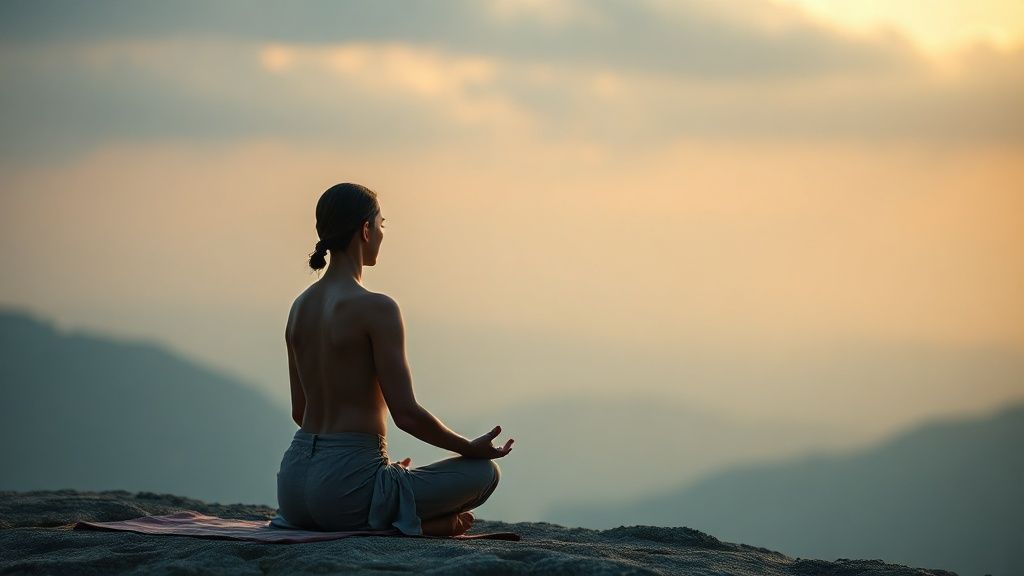
Posture Zazen: The Complete Guide to Correct Seated Meditation
Tried meditation but found your mind racing or your back aching? You’re not alone. Many beginners struggle with the physical aspect of meditation, mistakenly believing it’s all about emptying the mind. The secret often lies not in stopping your thoughts, but in mastering your posture. Zazen—the seated meditation practice at the heart of Zen Buddhism—treats posture not as a preliminary step, but as the practice itself.
Posture Zazen is the foundation upon which all other aspects of meditation rest. It’s not just sitting; it’s an active state of balanced alertness and relaxation that directly influences your mental state. When your body is properly aligned, your mind naturally follows toward calmness and clarity.
This comprehensive guide will break down the seven key elements of correct Zazen posture, explain why each component matters physiologically and mentally, and offer practical tips for beginners to find comfort and stability in their practice.

What Is Zazen? More Than Just Sitting
Zazen, literally translated as “seated meditation,” is the core practice of Zen Buddhism. Unlike guided meditations that use visualizations or mantras, Zazen is the practice of “just sitting” (Shikantaza)—observing thoughts, sensations, and sounds as they arise without attachment or judgment. It’s not about achieving a special state of consciousness but about being fully present with whatever is happening in this moment.
In Zazen, the posture itself is the expression of enlightenment. The physical form embodies the mental attitude of wakefulness, acceptance, and stability. This is why so much emphasis is placed on correct alignment—because how you sit directly shapes how you experience reality during practice.
Why Your Posture Is Everything in Zazen
The connection between physical posture and mental state isn’t just philosophical—it’s physiological. A stable, aligned physical posture directly facilitates a calm, focused, and alert mind through several mechanisms:
The Mind-Body Feedback Loop Neuroscience has demonstrated what Zen masters have known for centuries: our physical posture sends constant feedback to our brain about our state of being. A slumped posture can trigger stress responses, while an upright, open posture promotes feelings of confidence and calm.
Energy Flow Traditional teachings describe how proper posture allows for the smooth flow of energy (known as Ki or Qi) throughout the body. When the spine is aligned and the body balanced, energy moves freely without blockages. This prevents the two common obstacles in meditation: drowsiness (caused by stagnant energy) and agitation (caused by erratic energy flow).
Breath Capacity Your posture directly determines your breathing capacity. A collapsed chest restricts diaphragm movement, leading to shallow breathing that can increase anxiety. An upright spine with a naturally curved back allows for full, deep abdominal breathing that calms the nervous system.
The 7 Pillars of Correct Zazen Posture
Mastering these seven elements will transform your meditation from a struggle with discomfort into a foundation for profound practice.
1. The Foundation: Finding Your Seat
Your seating position creates the stable base from which everything else arises. The ideal position provides three points of contact with the ground, creating a stable tripod. Here are the primary options, from most to least stable:
Full Lotus (Padmasana) The classic Zazen position where each foot rests on the opposite thigh. This creates an extremely stable base but requires significant hip flexibility. Never force this position.
Half Lotus A more accessible variation where one foot rests on the opposite thigh and the other foot rests on the floor beneath the opposite knee. Remember to alternate which leg is on top between sessions.
Burmese Style Both legs are folded in front of you with knees touching the ground. This is often the most comfortable cross-legged position for beginners as it places less strain on the knees and hips.
Seiza (Kneeling) Using a meditation bench or cushion between your legs to support your weight while kneeling. Excellent for those with tight hips.
Chair Sitting Perfectly valid for Zazen. Sit forward on the chair so your back doesn’t touch the backrest, keeping your spine self-supported. Place feet flat on the floor directly under your knees.
For those who find seated postures challenging due to anxiety, a 5分钟焦虑与睡眠冥想 can be a gentler starting point to build comfort.
2. The Spinal Column: The Straight, Natural Back
The spine is the central pillar of Zazen posture. The goal isn’t a rigid, military-straight back but a naturally elongated spine that follows its gentle S-curve.
Technique: Imagine a string attached to the crown of your head gently pulling upward. As your head lifts, feel your spine lengthening between your tailbone and skull. Your lower back maintains its natural inward curve, your mid-back rounds slightly outward, and your neck curves gently inward to support your head.
Common Correction: Avoid thrusting your chest forward or pulling your shoulders back aggressively. The expansion should come from the lengthening of the entire spine, not from muscular tension in the upper back.
A straight back facilitates better breathing. Learn the fundamentals with this 10分钟呼吸冥想引导词.
3. The Hand Position: The Cosmic Mudra (Hokkaijōin)
The hand position in Zazen is rich with symbolic meaning and practical function. The Cosmic Mudra represents the unity of opposites and creates a contained energy circuit.
Formation: Rest your dominant hand palm-up in your lap. Place your other hand, also palm-up, on top so that the knuckles of both hands overlap. Gently touch the tips of your thumbs together, forming a soft oval. Your thumbs should be parallel to the floor, not pointing upward or drooping downward.
Placement: Rest the mudra against your lower abdomen, about two finger-widths below your navel—the center of your gravitational energy (known as the “hara” in Japanese tradition). Your arms should be relaxed with a little space between your elbows and torso.
4. The Gaze: Eyes Open, Softly Focused
Unlike many meditation traditions that recommend closed eyes, Zazen practice typically keeps the eyes partially open. This might feel strange at first but serves an important purpose.
仰卧屈膝,或舒适端坐于椅上。 Keep eyes open but with a softened focus, not staring intently. Gaze downward at approximately a 45-degree angle, focusing on the ground about 3-4 feet in front of you.
Purpose: Open eyes help maintain alertness and prevent drowsiness. More importantly, they express the Zen attitude of engaging with reality as it is, rather than withdrawing from it. You’re not trying to block out the world, but to sit in the midst of it without being distracted by it.
5. The Shoulders, Mouth, and Tongue
These subtle adjustments complete the holistic alignment of your posture:
Shoulders: Allow your shoulders to drop away from your ears. Roll them back and down to open your chest. Check periodically for tension, as shoulders tend to creep upward during meditation.
Mouth: Keep your mouth closed with your lips gently touching. Your jaw should be relaxed, with a slight space between your upper and lower teeth.
Tongue: Place the tip of your tongue lightly against the roof of your mouth, just behind your front teeth. This completes an energy circuit and reduces saliva production, minimizing the need to swallow.
6. The Breath: The Anchor of Your Practice
In Zazen, breath occurs naturally—you don’t force or control it. The posture itself enables optimal breathing.
Natural Abdominal Breathing: With your spine erect and your diaphragm free, your breath will naturally settle into your abdomen. Notice the gentle expansion of your lower belly on inhalation and the gentle contraction on exhalation.
呼吸节奏: 不要刻意控制呼吸的长度或速度。只需如实地观察它。当你放松进入坐姿时,呼气通常会自然延长。.
如果你有焦虑性呼吸模式的困扰,在开始坐禅前练习 缓解焦虑的腹式呼吸法 可以帮助重新训练你的身体。.
7. 处理不适与疼痛
一些不适感是正常的,尤其是在刚开始时。学习与不适感共处是修行的一部分。.
“良性”疼痛与“不良”疼痛: “良性”疼痛是肌肉伸展和放松的感觉——一种弥散性的钝感。“不良”疼痛则是尖锐的、刺痛的,或集中在关节部位。遇到不良疼痛时务必调整姿势。.
微调: 当不适感出现时,首先温和地将觉知带到该感觉上,不要立即移动。如果需要,可以进行微小的姿势调整——轻微转移重心、略微延展脊柱一毫米。通常,通过专注的觉知而非大幅度的动作,不适感便会消散。.
何时移动: 如果疼痛变得尖锐或令人分心,请有意识地改变你的姿势。折磨自己并无益处。目标是警觉的放松,而非耐力测试。.
将简短的 睡眠身体扫描冥想 纳入你的日常练习,可以增强身体觉知,帮助你在坐禅前注意到身体的紧张。.

常见坐禅姿势错误(及纠正方法)
即使意图良好,细微的姿势错位也可能影响你的修行。以下是最常见的问题及其解决方法:
弓背(瘫坐) 这会挤压胸腔并限制呼吸。. 纠正方法: 定期检查你的姿势,重新建立从头顶向上的延展感。.
过度挺胸 这会导致上背部和肩部紧张。. 纠正方法: 在保持脊柱延展的同时,放松胸骨使其自然下沉。胸腔的扩张应感觉毫不费力。.
强迫双腿进入疼痛的姿势 这会制造干扰而非稳定。. 纠正方法: 选择一个能让膝盖低于臀部的坐姿。使用更高的坐垫,或尝试完全不同的姿势。.
睡着 这表明你的姿势已经垮塌,能量停滞。. 纠正方法: 睁大眼睛,挺直脊柱,并将注意力带回呼吸。如果困意持续,尝试在一天中的其他时间冥想。.
为坐禅准备身心
简短的准备练习可以显著改善你的静坐体验。.
简单拉伸以获得更舒适的坐姿
坐前花2-3分钟准备身体:
蝴蝶式拉伸: 坐姿,脚底相对,双膝向两侧打开。轻柔地向前折叠以打开髋部。.
坐姿扭转: 盘腿坐,将一只手放在对侧膝盖上,另一只手放在身后。轻柔地扭转看向后方,然后换边。.
猫牛式拉伸: 双手和双膝着地,交替拱起上背部和下沉腰部以活动脊柱。.
培养正确的心态
以不刻意追求的态度进行坐禅。你不是试图达成什么或到达别处。你是在练习全然安住于当下升起的一切——包括不适、无聊或内心的杂念。.
A 简短的引导冥想 是从繁忙一天过渡到坐禅练习的极佳方式。.

坐禅姿势常见问题解答(适用于语音搜索和精选摘要)
坐禅姿势中最重要的部分是什么?
是挺直而自然的脊柱。它是允许正确呼吸和精神警觉的核心支柱。所有其他要素都支撑或辅助脊柱的对齐。.
如果无法坐在地板上,可以进行坐禅吗?
当然可以。在椅子上挺直坐好,双脚平放于地面,是完全有效的坐禅姿势练习方式。关于脊柱、手部和视线的基本原则完全不变。.
我应该保持坐禅姿势多久?
从5-10分钟的短时间开始,逐渐增加。持续性比时长更重要。每天坐10分钟比每周只坐一小时更好。.
A 5分钟晨间引导冥想 是建立持续、简短每日练习的完美方式。.
为什么坐禅要睁着眼睛?
为了避免昏沉,并练习全然临在、觉知周围环境,而非从中抽离。睁眼的方式体现了禅宗将冥想觉知带入所有活动,而不仅仅是正式打坐的理想。.
结语:你的姿势,你的修行
掌握坐禅姿势是一段旅程,而非一个终点。它是一种正念的、觉醒的、平衡的心灵的物质表达。每次你将身体调整到这个对齐、接纳的姿势时,你不仅仅是在准备冥想——你就是在冥想。姿势本身成为老师,当你的心游移时,它会不断地引导你回到临在状态。.
既然你已理解了基本原理,是时候开始练习了。找一个安静的空间,设定5分钟的计时器,并首先专注于你的姿势。请记住,目标不是完美,而是持续、正念的练习。如需进一步指导,请探索我们的资源库以深化你的冥想之旅。.
如果你对引导式练习完全陌生,可以从 最适合初学者的引导冥想 开始,以熟悉整个过程。.
元数据开始—
分类:初学者正念指南
显示标题:坐禅姿势:正确坐姿冥想的完整指南
搜索引擎优化标题:坐禅姿势指南 | 正确坐姿冥想技巧
元描述:通过我们的完整指南掌握坐禅姿势。学习正确坐姿冥想的7个支柱,以获得更好的专注、平静和正念练习。.
图片提示:一个人以完美的坐禅冥想姿势坐在坐垫上,身处宁静的房间,拥有柔和的自然光线,展示挺直的脊柱、宇宙手印手势以及柔和的下垂目光。
IMG_ALT:演示正确坐禅姿势者,脊柱挺直,手结宇宙印
IMG_TITLE:坐禅姿势——视觉图示
IMG_CAPTION:禅修基础:正确的坐禅姿势对齐
IMG_DESC:一位冥想者在宁静环境中展示完美的坐禅姿势:脊柱对齐、双肩放松、手结宇宙印、目光柔和垂视
—元数据结束—