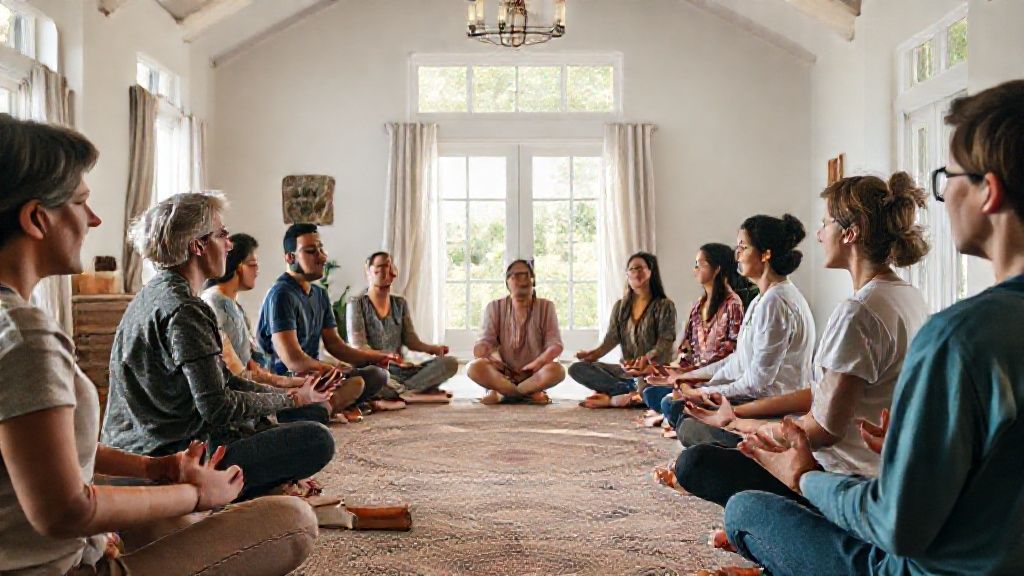
团体最佳正念活动终极指南
Does this sound familiar? Your team at work feels disconnected and stressed before a big project. Your family dinner is filled with distracted glances at phones instead of meaningful conversation. Your classroom of students seems more chaotic and unfocused than ever. In our hyper-connected world, genuine connection often gets lost in the noise.
The best mindfulness activities for groups are those that are engaging, accessible, and foster a shared sense of calm and connection. This guide provides a curated list of fun, effective exercises designed to bring any team, family, or classroom closer together while reducing collective stress, improving communication, and strengthening bonds.
Why Group Mindfulness Is a Game-Changer
While solo mindfulness practice offers tremendous benefits, practicing mindfulness in a group setting amplifies these advantages exponentially. When people come together with a shared intention of presence and awareness, something remarkable happens—the collective energy shifts. The calm of one person begins to influence their neighbor, creating a ripple effect throughout the entire group.
Group mindfulness builds what psychologists call “shared experiential grounding”—a common reference point that strengthens relationships and creates lasting bonds. Unlike individual practice where you might question if you’re “doing it right,” group settings provide validation and normalization of the experience. You hear others describe similar sensations and challenges, which reduces self-judgment and increases self-compassion.
The social reinforcement of practicing with others also boosts motivation and consistency. When you know your team, family, or classmates are counting on your participation, you’re more likely to show up fully. This communal accountability transforms mindfulness from a personal chore to a shared commitment.
For those completely new to the concept, start by 了解引导冥想的基础知识 to build a solid foundation for group practice.

The Golden Rules for Leading Group Activities
Before diving into specific activities, establishing the right environment and approach is crucial for success. As a facilitator, your primary role isn’t to be a perfect expert but to create a container where exploration feels safe and inviting.
First, set clear expectations at the beginning. Explain that there’s no “right” way to experience mindfulness and that wandering thoughts are completely normal. Emphasize that this is a judgment-free zone—both toward others and oneself.
Second, model vulnerability and authenticity. If you’re nervous, say so. If your mind wanders during an activity, acknowledge it. Your willingness to be human gives others permission to do the same.
Third, start small and keep it light. For beginners, a 3-minute activity that feels enjoyable is far more valuable than a 30-minute session that feels like a chore. Use encouraging language and remind participants that they can modify any activity to suit their comfort level.
Fourth, create a physically comfortable environment. Ensure the space is relatively quiet, at a comfortable temperature, and free from major distractions. If possible, dim bright lights and make seating arrangements that feel inclusive rather than hierarchical.
If you want to deepen your skills in this area, our guide on 引导冥想会话的技巧 offers more detailed facilitation strategies.
5 Fun & Engaging Mindfulness Activities for Any Group
1. The Sound Scavenger Hunt
Description: This listening meditation transforms ordinary sounds into objects of curious exploration. Guide participants to sit comfortably and close their eyes if they wish. Explain that you’ll spend the next 3-5 minutes in silence, simply noticing sounds. The “scavenger hunt” aspect comes from mentally noting as many different sounds as possible—both obvious and subtle.
Why it Works: This activity brilliantly anchors attention in the present moment through the auditory sense. Unlike visual-focused activities, closing eyes to listen often feels less intimidating for beginners. Participants frequently discover sounds they hadn’t noticed before—the hum of electronics, distant traffic, their own breathing—which expands their awareness of the richness of ordinary moments.
建立可持续的放松习惯 After the listening period, invite volunteers to share one surprising sound they noticed. This sharing reinforces the experience and often reveals how different people notice different aspects of the same environment.
This activity builds beautifully on core mindfulness skills. Consider having participants hone your senses with this foundational exercise beforehand to enhance their listening awareness.
2. The 5-Minute Group Body Scan
Description: A body scan involves systematically bringing attention to different parts of the body. For groups, a shortened 5-minute version works perfectly. Guide participants to sit or lie down comfortably. Using a calm voice, direct attention slowly from the soles of the feet up to the crown of the head, spending about 20-30 seconds on each major body area.
Sample Script Snippet: “Bring your awareness to your feet… noticing any sensations—tingling, warmth, the pressure against your shoes or the floor… without trying to change anything, simply observing… Now gently shift your attention to your ankles and lower legs…”
Why it Works: The body scan promotes interoception—awareness of internal bodily sensations—which is strongly linked to emotional regulation. When practiced in a group, this shared journey through the body creates a powerful collective calm. Participants often report feeling more grounded and physically relaxed afterward.
For those who want to continue this practice individually, you can download our free 5-minute body scan script to use anytime.
3. Pass the Pulse
Description: This non-verbal connection game requires the group to stand in a circle holding hands. One person starts by gently squeezing the hand of the person to their right. That person then passes the “pulse” to the next person, and so on, until it travels completely around the circle. For an added challenge, try sending multiple pulses at once or changing direction.
Why it Works: Pass the Pulse requires focused attention and non-verbal communication, making it excellent for building group cohesion. The physical contact (even just hand-squeezing) releases oxytocin, the “bonding hormone,” which enhances feelings of trust and connection. Teams often find that their coordination improves with practice, metaphorically demonstrating how attunement benefits collaborative work.

4. Mindful Doodling Together
Description: Provide paper and pens to each participant. Explain that this isn’t about creating “art” but about experiencing the physical sensation of drawing without attachment to the outcome. Guide them to place pen to paper and simply allow shapes, lines, and patterns to emerge without planning. Encourage focus on the feeling of the pen moving across the paper, the sound it makes, and the visual patterns developing.
Why it Works: Mindful doodling bypasses the performance anxiety that often accompanies drawing activities. Since there’s no “right” way to doodle, participants can fully immerse in the sensory experience. The activity is particularly effective for groups that include both self-identified “creative” and “non-creative” people, as it levels the playing field through its process-oriented nature.
This is one of many effective discover more calming activities for stressful moments that can help regulate the nervous system during tense periods.
5. The “I Notice…” Circle
Description: Gather participants in a circle. Explain that you’ll go around with each person completing the sentence “Right now, I notice…” with a simple, non-judgmental observation. Examples might include: “…the feeling of my feet on the floor,” “…the sound of the air conditioner,” “…a slight tension in my shoulders,” or “…the color of the wall across from me.”
Why it Works: This activity cultivates present-moment awareness while building emotional intimacy through shared vulnerability. Hearing others’ observations normalizes internal experiences and often reveals how differently people perceive the same environment. The structure provides equal speaking opportunity, ensuring all voices are heard—a particularly valuable dynamic for work teams where certain members typically dominate conversation.
Tailoring Activities for Specific Groups
Mindfulness for Team Building at Work
In workplace settings, mindfulness activities should align with organizational goals like improved focus, communication, and stress resilience. Before important meetings, try a 2-minute “Focus Breath” where everyone simply follows their breath together. This synchronizes the group’s energy toward the upcoming task.
After challenging deadlines or stressful periods, a “Shared Appreciation” practice works wonders. Go around the room with each person acknowledging one colleague’s contribution to the recent project. This reinforces positive connections and helps process completion before moving to the next task.
For ongoing workplace stress management, consider incorporating our guided meditation for work-related stress into regular team routines.
Mindfulness for Families & Kids
Family mindfulness should be playful, brief, and integrated into existing routines. Try “Mindful Bites” during meals—spending one minute silently noticing the colors, smells, textures, and tastes of food before eating. Or implement “Breathing Buddies” where young children lie down with a stuffed animal on their belly, watching it rise and fall with each breath.
For transitioning between activities, a “Mindful Bell” practice works well—ringing a bell and having everyone listen silently until they can no longer hear the sound. This creates instant calm during chaotic moments.
对于年幼儿童,, 可尝试专为儿童设计的快速正念时刻, 以适应其注意力持续时间。您还可以辅以我们 免费提供的青少年正念练习册 来延伸课程间隙的学习效果。.
课堂正念实践(中学阶段)
在教育场景中,正念活动应帮助学生实现学科间的过渡、缓解考前紧张并提升专注力。考试前,“三分钟呼吸空间”能显著降低焦虑感。课间进行的“正念姿势觉察”——让学生单纯觉察自己的坐姿或站姿而不作改变——有助于重置注意力。.
对于小组项目,“正念倾听配对”能培养沟通技巧:学生两人一组,一人发言一分钟,另一人全程倾听不打断,随后交换角色。.
教育工作者若希望 探索更多适合青少年的正念技巧, 可获取适龄策略指南。对于引导这些实践的教师,我们关于 教育者正念策略的资源 可提供额外支持。.

应对团体正念常见挑战
即使采用最佳活动方案,引导者仍常遇到可预见的挑战。掌握应对这些时刻的方法能确保活动体验不受影响。.
嬉笑与自我意识过强: 尤其在青少年或新团体中,紧张引发的笑声很常见。无需制止,可幽默化解:“我知道起初可能感觉不太习惯——这完全正常。让我们试着觉察这些笑意,而不被其裹挟。”这种接纳通常能消解紧张氛围。.
质疑态度: 部分参与者可能质疑正念的价值。在认可其观点的同时邀请尝试:“您无需相信这一定有效——只需将其视为实验,观察自己的感受。”通过降低完全认同的要求来减少抵触情绪。.
参与度不均: 任何团体中都存在参与热情差异。需强调所有参与程度都值得欢迎,包括单纯观察。强制参与易引发抵触,而开放邀请往往最终能带动怀疑者加入。.
时间限制: 时间有限时应调整而非放弃活动。60秒呼吸练习仍能带来益处。持续坚持比单次时长更重要。.
常见问题解答
大型团体最简单的正念活动是什么?
“一分钟呼吸练习”可谓最简单且最具扩展性的活动。让所有人舒适就坐,仅需专注自然呼吸60秒。除觉察吸气和呼气外无需特殊指导。该活动适用于5至500人的团体,且无需器材。如需引导支持,可 参照我们的一分钟呼吸练习指南.
正念活动能缓解团体焦虑吗?
当然可以。焦虑在团体中具有传染性,但平静亦然。集体呼吸与 grounding 练习能激活整个团体的副交感神经系统(“休息与消化”反应),从生理层面实现焦虑状态的转换。共同体验还能减少焦虑常伴随的孤立感。如需更专业的方法,, 可在此了解更多缓解焦虑的技巧.
团体正念课程应持续多久?
对初学者而言,5-15分钟是最佳时长。目标是让参与者意犹未尽而非如释重负。随着团体正念“肌肉”的增强,可逐步延长至20-30分钟。需注意:每周多次简短练习通常比单次长时间课程更有益。.
引导这些活动需要特殊培训吗?
实施本指南中的活动无需特殊认证。真诚的意愿、安全的空间以及与参与者共同学习的态度才是最重要的资质。当然,如果您希望 通过我们的引导技巧提升信心,, 额外资源可帮助增强相关技能。.
结论与行动呼吁
融入趣味性团体正念活动,是增强联结、提升专注力与促进集体福祉最有效且易行的方式之一。无论您希望加强工作团队凝聚力、为家庭生活注入更多临在感,还是营造更宁静的课堂环境,这些练习都提供了尊重个体与团体体验的实用起点。.
团体正念的真正魅力不在于完美执行,而在于共同的意愿。当人们怀着对当下体验的开放好奇心相聚时,转变便会自然发生——每一次呼吸,每一次活动,皆成契机。.
准备好为您的社群注入正念了吗? 请收藏本指南 用于下次团体活动,或 保存此页面 **5分钟正念冥想** 深化实践,探索共同培养临在感的新途径。.