运动后冥想:冷却身心终极指南 - 生活
You’ve just crushed your workout. Your heart is pounding, your muscles are buzzing, and your mind is still racing with the remnants of adrenaline and effort. But before you rush off to your next task, scroll through your phone, or dive back into your day, there’s a powerful, often-overlooked practice that can amplify your physical gains, speed up your recovery, and bring a profound sense of calm: after exercise meditation.
This isn’t just another item to add to your already-long to-do list. It’s the missing link that transforms a good workout into a holistic ritual for well-being. This guide will teach you exactly how to use post-workout meditation to seamlessly transition from a state of high intensity to one of deep recovery and mental clarity, ensuring you get the most out of every single sweat session.

Why Your Post-Workout Routine is Incomplete Without Meditation
We spend hours perfecting our form, tracking our macros, and pushing our physical limits. Yet, we often neglect the crucial window of time immediately following our workout—a period when our body and mind are uniquely primed for integration and healing. Adding just a few minutes of meditation can be the game-changer that elevates your entire fitness journey.
From Sympathetic to Parasympathetic: Calming Your Nervous System
During intense exercise, your body is in a state of sympathetic nervous system dominance—the famous “fight or flight” mode. Your heart rate is up, cortisol is flowing, and your body is ready for action. While this is essential for performance, lingering in this state post-workout can hinder recovery and keep you feeling jittery and on-edge.
After exercise meditation acts as a deliberate switch, guiding your system into the parasympathetic, or “rest and digest,” state. By focusing on your breath and bodily sensations, you send a direct signal to your brain that the perceived “threat” (the workout) is over. This lowers your heart rate, reduces blood pressure, and initiates the body’s natural repair processes. It’s the conscious cool-down for your nervous system.
Enhance Muscle Recovery and Reduce Inflammation
The benefits aren’t just psychological; they’re physiological. Intense physical activity creates microscopic tears in muscle fibers and triggers inflammatory responses. This is a normal part of building strength, but how quickly you recover depends on your body’s ability to manage this inflammation.
Studies have shown that mindfulness and meditation practices can lead to reduced levels of cortisol, the primary stress hormone that, when chronically elevated, can break down muscle tissue and promote inflammation. Furthermore, the deep relaxation achieved through meditation improves blood flow, delivering oxygen and nutrients more efficiently to fatigued muscles, thereby accelerating the repair process.
Lock in Your Mind-Muscle Connection and Mental Gains
Your workout builds more than just muscle; it builds mental fortitude, discipline, and focus. Meditation provides the space to consolidate these mental gains. By sitting in stillness after pushing your limits, you reinforce the neural pathways associated with perseverance and body awareness.
This practice strengthens the mind-muscle connection, making you more attuned to your body’s signals in future workouts. It also allows you to bask in the accomplishment of your effort, releasing endorphins in a calm, controlled manner rather than crashing from an adrenaline high. This creates a positive feedback loop, making you more likely to view exercise as a rewarding, sustainable practice.
The Perfect 10-Minute After Exercise Meditation Routine
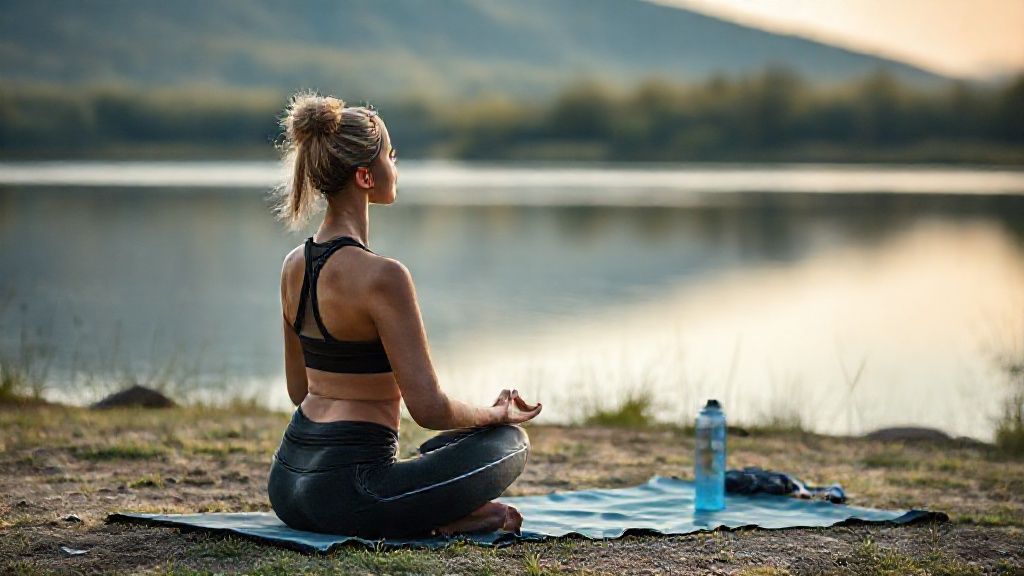
You don’t need a silent retreat or an hour of spare time. This simple, effective 10-minute routine is designed specifically for the post-exercise state. Find a quiet spot, perhaps still on your gym mat or in a peaceful corner at home.
Step 1: Conscious Cool-Down & Body Awareness (2 minutes)
Begin by finding a comfortable seated or even lying down position. Close your eyes. Don’t try to force your breath or clear your mind just yet. Instead, bring your awareness to the physical sensations in your body.
- Notice the residual heat in your muscles.
- Feel your heart rate gradually slowing down.
- Acknowledge any areas of tension or fatigue without judgment.
- Simply scan from the top of your head down to your toes, just observing what’s present.
This initial body scan is a powerful way to transition from external exertion to internal awareness. It grounds you in the present moment and your physical form. For a more structured approach to this practice, you can use our short body scan meditation script.
Step 2: Focused Breathwork to Regulate Heart Rate (3 minutes)
Now, gently guide your attention to your breath. Don’t force it to be deeper or slower than is natural; just observe its current rhythm.
- 将一只手放在胸前,另一只手放在腹部。.
- Feel the rise and fall of each inhalation and exhalation.
- After a minute of observation, begin to gently lengthen your exhales. Try inhaling for a count of four, and exhaling for a count of six.
- This extended exhale actively stimulates the vagus nerve, a key component of the parasympathetic nervous system, encouraging your body to relax and your heart rate to settle.
This focused breathing is a cornerstone of post-workout recovery. For a deeper dive into various techniques, explore our dedicated 10-minute breathing meditation guide.
Step 3: Guided Visualization for Recovery (5 minutes)
With your body calm and your breath regulated, engage the power of your mind to direct your recovery. This is where you actively participate in the healing process.
- Visualize your breath as a wave of soothing, cool, oxygen-rich energy.
- On each inhale, imagine this energy flowing directly to the muscles that feel the most worked or tired.
- Picture it as a healing light, washing away metabolic waste like lactic acid and delivering vital nutrients for repair.
- See your muscles relaxing, lengthening, and becoming stronger with each breath. You might even visualize them mending the microscopic tears, emerging more resilient than before.
This proactive visualization can have a tangible impact on your recovery mindset and process. For more guided imagery techniques tailored to different goals, check out our library of guided visualization meditations.

Tailoring Your Post-Workout Meditation to Your Needs
Not all workouts are created equal, and neither should your meditation be. You can customize your approach based on the type of exercise you’ve just completed.
For High-Intensity Interval Training (HIIT) or Cardio
After a HIIT session or a long run, your primary challenge is a racing heart and breathlessness. Your meditation should directly address this.
- Focus: Calming the cardiovascular and respiratory systems.
- Technique: Prioritize the breathwork segment (Step 2). Spend more time here, focusing exclusively on elongating your exhales until your breathing feels smooth and controlled. The body scan can be brief, simply acknowledging the high-energy state before gently guiding your focus to the breath.
- Quick Tip: If you’re really short on time or too amped up, even a focused 一分钟呼吸练习 can work wonders to reset your system.
After Strength Training or Weight Lifting
Post-lifting, the sensation is often one of deep muscular fatigue and localized tension.
- Focus: Releasing specific muscle groups and visualizing strength.
- Technique: Emphasize the body scan (Step 1) and visualization (Step 3). During the scan, spend extra time on the muscles you targeted—your quads after squats, your back after rows, etc. Acknowledge the “burn” and then, in the visualization, imagine a feeling of release and expansion in those areas. Visualize the muscle fibers thickening and strengthening.
If You’re Feeling Stressed or Anxious Post-Workout
Sometimes, the mental clutter you hoped to sweat out persists, or the physical stress of exercise can even heighten underlying anxiety.
- Focus: Grounding and emotional regulation.
- Technique: Incorporate a strong grounding element. Before even starting the body scan, feel the points of contact between your body and the floor or mat. Feel the solidity beneath you. If your mind is racing about your day, acknowledge the thoughts and then gently return to the physical sensation of your body being supported. If this is a common experience, a dedicated 缓解焦虑的引导冥想 can provide more structured support.
Common Challenges & Quick Fixes
It’s normal to encounter hurdles when starting a new practice. Here’s how to navigate the most common ones.
-
“I’m too amped up to sit still.”
- 纠正方法: 不要强迫自己静坐不动。尝试步行冥想。缓慢而有意识地踱步,将呼吸与步伐协调起来。或者,从一项高度投入的 简短的引导冥想 开始,其中的语音引导有助于锚定你的注意力。.
-
“我没有10分钟时间。”
- 纠正方法: 有一点总比完全没有好。“全有或全无”的心态是最大的障碍。即使是60秒的专注呼吸也会对你的恢复产生积极影响。承诺进行更短但更持续的练习。我们的 3分钟引导式冥想 非常适合这些时间紧迫的日子。.
-
“我的思绪一直在不停地想着我这一天的事。”
- 纠正方法: 这并非失败的标志;这正是练习的全部意义所在!目标不是停止思考,而是觉察它们,并温和地将注意力带回到你的锚点(呼吸或身体)。每次这样做,你都在增强你的正念“肌肉”。如果思绪特别纷乱,可以尝试一段 简短的接地冥想引导词, 它运用5-4-3-2-1方法来调动你的感官。.

常见问题解答
运动后应该等多久再进行冥想?
你可以在完成放松拉伸后立即开始。无需等待。目标是实现从身体活动到精神休息的平稳过渡,因此利用运动后即刻的窗口期是最理想的。.
冥想可以替代我运动后的拉伸吗?
不能,它是一个强大的补充,而非替代品。静态拉伸针对肌肉弹性和灵活性,而冥想则针对神经系统调节和精神恢复。可以将其视为心灵的拉伸,这反过来又能增强肌肉拉伸带来的身体益处。.
如果我在冥想时睡着了怎么办?
这完全正常,并且表明你的身体需要休息!睡着意味着你已成功激活副交感神经系统,并让你的身体得到了真正的放松。如果你的目标是保持清醒进行正念练习,可以尝试以坐姿而非躺姿进行冥想。.
运动后最适合进行哪种类型的冥想?
身体扫描、呼吸正念和引导式可视化是最有效的,因为它们直接针对身体感觉和神经系统。对于初学者来说, 一段平静的引导冥想 是一个极佳的起点,因为它能在你思绪可能涣散时提供结构和方向。.
总结与行动号召
After exercise meditation 是弥合体力消耗与整体健康之间差距的秘密武器。正是这项练习,确保你投入锻炼的自律和努力转化为持久的身心回报。只需为你的心灵投入10分钟进行这项强大的“冷却”,你就能将日常锻炼从一个简单的健身任务,转变为一种深刻的自我关怀仪式。.
结束时,你将不仅感到身体上的释放,更能获得思绪清晰、情绪平衡和真正的恢复感。.
准备好改变你的恢复方式,释放锻炼的全部潜能了吗? 从今天开始,实践上述简单的10分钟流程。在养成这个新习惯时,对自己保持耐心。如果你是冥想新手并希望获得更多指导,可以探索我们设计的资源库,它们旨在帮助你建立一个持续且有益的正念习惯。你可以从迈出第一步开始: 了解更多关于引导式冥想.