Zen and Mindfulness: A Practical Guide to Present-Moment Awareness
In a world of constant distraction, notifications, and endless to-do lists, the ancient practice of Zen offers a profound path to what so many of us seek: true mindfulness. The terms “Zen” and “mindfulness” are often used interchangeably, but what do they really mean, and how can their timeless wisdom be applied to your modern, hectic life? This comprehensive guide demystifies the deep connection between Zen Buddhism and mindfulness, moving beyond trendy buzzwords to provide you with actionable steps to cultivate a calmer, more focused, and deeply present mind. You’ll learn the core philosophical principles, discover simple yet transformative daily practices, and find valuable resources to guide your journey into authentic present-moment awareness.

What is Zen Buddhism? The Foundation of Mindfulness
To understand Zen mindfulness, we must first explore its roots. Zen is a school of Mahayana Buddhism that originated in China (as Chan) and later flourished in Japan, Korea, and Vietnam. It emphasizes the direct, experiential realization of one’s true nature, often through meditation and interaction with a teacher, rather than through scripture study alone.
Beyond Sitting: The Core Philosophy of Zen
At its heart, Zen is not merely a meditation technique; it is a way of life grounded in several key principles:
- Direct Experience: Zen values firsthand experience over intellectual knowledge. It’s about tasting the sugar yourself rather than reading a description of its sweetness. The goal is to see reality as it is, directly and immediately, without the filter of our conceptual thinking.
- Non-Attachment: This is a cornerstone of Zen practice. It doesn’t mean becoming cold or detached from life. Instead, it’s about learning to relate to thoughts, emotions, and sensations without clinging to them or pushing them away. You observe them as they arise and pass, like clouds moving across the sky.
- Impermanence (Mujo): Zen teaches that all things are in a constant state of flux. Understanding and accepting this fundamental truth helps reduce suffering, as we stop trying to hold onto what is inherently transient—be it a pleasant feeling, a possession, or even life itself.
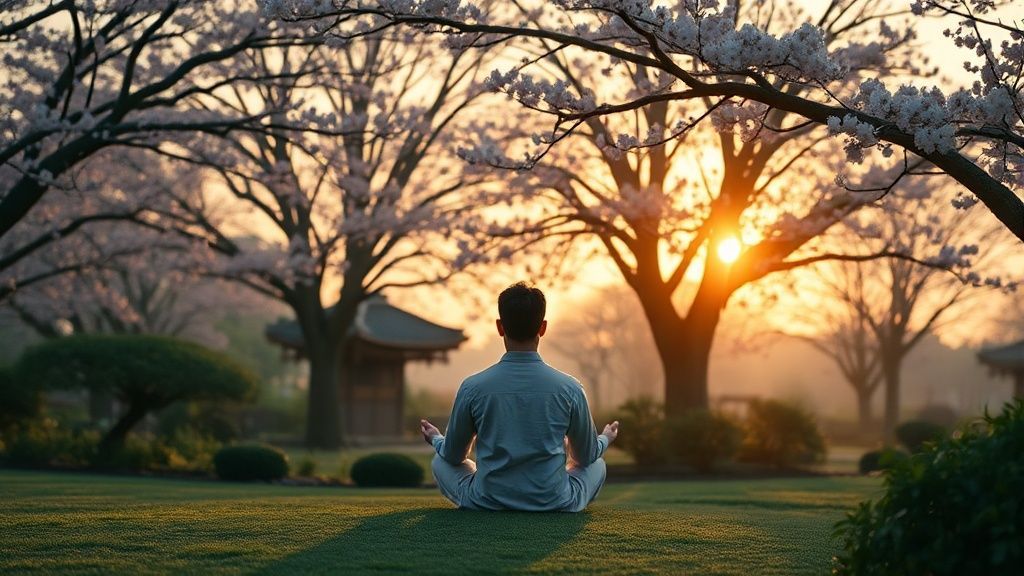
The physical practice that embodies these principles is Zazen, or seated meditation. It is considered the heart of Zen, a practice where one simply sits, alert and upright, letting go of all gaining ideas and allowing the mind and body to settle into their natural state.
How Zen Differs from Modern Mindfulness
While deeply connected, it’s helpful to understand the distinction. Modern, secular mindfulness—often taught in corporate or therapeutic settings like Mindfulness-Based Stress Reduction (MBSR)—is frequently goal-oriented. The aim might be to reduce stress, improve focus, or enhance emotional regulation.
Zen, however, is a holistic spiritual path. Its ultimate aim is Satori, or enlightenment—a profound awakening to your true nature and the nature of reality. Mindfulness, in the Zen context, is not a tool for a better life, but a natural byproduct and essential component of walking the path toward this awakening. Zen mindfulness is the practice of bringing this awakened awareness to every single moment, whether you are on the meditation cushion or washing the dishes.
The Zen Path to Mindfulness: Core Practices for Daily Life
The beauty of Zen is its profound simplicity. The practices are straightforward, yet their depth is limitless. Here’s how you can begin to incorporate them into your own life.
Zazen: The Art of “Just Sitting”
Zazen is the foundational practice of Zen. The term literally means “sitting meditation,” but its essence is “just sitting” without any goal or agenda. Here is a basic step-by-step guide to get you started:
- Posture: Find a quiet space. Sit on a cushion (zafu) on the floor, cross-legged, or in a chair with your feet flat on the floor. The key is to keep your spine erect and natural, not rigid. Tuck your chin in slightly. Your hands should rest in your lap in the “cosmic mudra”—left hand on top of the right, palms up, with thumbs lightly touching, forming a gentle oval.
- Gaze: Keep your eyes open but softly lowered, gazing at a point on the floor about two to three feet in front of you. This helps maintain alertness and prevents you from getting lost in daydreams.
- Breath Awareness: Bring your attention to your breath. Don’t try to control it. Simply notice the natural inflow and outflow. Many practitioners focus on the Hara (a point about two inches below the navel), feeling the breath originate from and return to this center of gravity.
- Dealing with Thoughts: Thoughts will arise. This is natural and not a sign of failure. The practice is to notice the thought without judgment, let it go, and gently return your attention to the breath. Imagine your thoughts as leaves floating down a stream; you see them, but you don’t jump in and grab them.
For a structured way to begin your sitting practice, try our méditation guidée de 5 minutes.
Bringing Mindfulness Off the Cushion
True Zen practice isn’t confined to the meditation hall. The real test is whether you can carry that mindful awareness into your everyday activities. This is often called “mindfulness in action.”
- Alimentation en pleine conscience : For your next meal, eat without distractions. Put away your phone and turn off the TV. Notice the colors, textures, and smells of your food. Chew slowly, savoring each bite. Be grateful for the nourishment.
- Mindful Walking (Kinhin): Walk slowly and deliberately, coordinating your breath with your steps. Feel the sensation of your feet making contact with and leaving the ground. This can be done as a formal practice or simply while walking from your car to the office.
- Écoute en pleine conscience : When in conversation, try to listen completely, without formulating your response while the other person is talking. Give them your full presence.
Incorporate brief moments of awareness with this exercice de respiration d’1 minute.

Overcoming Common Challenges with Zen Mindfulness
It’s normal to encounter obstacles on this path. Recognizing them is the first step to working with them skillfully.
When Your Mind Won’t Be Still: Dealing with Anxiety and Overthinking
Many beginners believe the goal of meditation is to “empty the mind” or stop thinking. This is a misconception that leads to frustration. In Zen, thoughts are not the enemy. The practice is to change your relationship with your thoughts.
Instead of getting tangled in a thought or fighting against it, you learn to observe it with detachment. See anxiety as a passing weather pattern in the vast sky of your awareness. The sky is always present and untouched, regardless of whether there are stormy clouds (anxious thoughts) or clear blue skies (calm). By repeatedly returning to the anchor of your breath, you train the mind to not be swept away.
If anxiety is a significant barrier, this méditation guidée pour l'anxiété et la dépression can provide supportive, compassionate guidance.
Finding Time and Consistency
The biggest challenge for modern practitioners is often finding the time and motivation to practice regularly. Zen wisdom offers a solution: prioritize consistency over duration.
A daily practice of just 5 to 10 minutes is far more powerful than an hour of meditation once a month. The goal is to weave mindfulness into the fabric of your life. It’s better to sit for a short time every day than to have long, sporadic sessions that feel like a chore.
- Anchor your practice: Link your meditation to an existing habit, like right after you brush your teeth in the morning or right before you have your evening tea.
- Créez un espace dédié : Even a small corner with a cushion can serve as a powerful visual reminder to practice.
Build a sustainable habit with a Méditation guidée courte qui s’adapte à tout emploi du temps.
Approfondir votre pratique : ressources et prochaines étapes
Au fur et à mesure que votre intérêt et votre engagement grandissent, vous pourriez souhaiter explorer davantage. Le chemin du Zen est une voie d’apprentissage et d’approfondissement continus.
Méditations guidées dans l’esprit du Zen
Bien que le Zazen traditionnel soit souvent silencieux, les méditations guidées peuvent constituer un excellent point de départ. Elles offrent une structure et des rappels doux qui aident à ancrer un esprit vagabond. Considérez-les comme des roulettes d’apprentissage ; c’est un outil de soutien à utiliser jusqu’à ce que vous vous sentiez à l’aise en assise silencieuse.
- Pour une session plus longue et immersive, cette méditation guidée de 20 minutes est excellente pour cultiver une concentration profonde.
- Terminez votre journée en pleine conscience avec une méditation guidée pour le sommeil et la guérison.
Explorer davantage : enseignants, communautés et formation
Le Zen a une longue tradition d’apprentissage auprès d’un enseignant (Roshi ou Sensei) et de pratique au sein d’une communauté (Sangha). Un bon enseignant peut offrir un accompagnement personnalisé, répondre à vos questions et vous aider à naviguer dans les subtilités de la voie.
- Trouver un centre local : Recherchez un centre Zen ou un temple bouddhiste dans votre région. Beaucoup proposent des soirées débutants, des ateliers et des séances de méditation régulières.
- Communautés en ligne : À l’ère numérique, de nombreux enseignants et communautés réputés proposent des cours en ligne, des séances en direct et des retraites virtuelles.
- Approfondir votre étude : Lisez les œuvres de maîtres fondateurs du Zen comme Shunryu Suzuki (Esprit Zen, esprit neuf), Thich Nhat Hanh et D.T. Suzuki.
Approfondissez votre compréhension avec les enseignements de Thich Nhat Hanh grâce à ce guide de méditation de Thich Nhat Hanh.
Envisagez de formaliser votre pratique en explorant les voies pour devenir un coach en pleine conscience certifié.

FAQ sur le Zen et la pleine conscience (pour recherche vocale et extraits en vedette)
Quelle est la différence entre le Zen et la pleine conscience ?
La pleine conscience est un état de conscience non jugeante de l’instant présent, qui est à la fois un élément clé et un résultat de la pratique de la voie spirituelle plus large qu’est le Bouddhisme Zen. Le Zen est le chemin ; la pleine conscience est une qualité fondamentale cultivée sur ce chemin.
Comment pratiquer la pleine conscience Zen ?
La pratique formelle principale est le Zazen, ou méditation assise, où l’on observe sa respiration et ses pensées sans jugement. De manière informelle, on pratique en portant une attention consciente aux activités quotidiennes comme marcher, manger et écouter.
La pleine conscience peut-elle aider contre l’anxiété ?
Oui, en vous entraînant à observer les pensées anxieuses et les sensations physiques sans vous y engager ni les alimenter, la pleine conscience, telle qu’enseignée dans le Zen, peut réduire significativement l’impact et la fréquence de l’anxiété. Pour des pratiques spécifiques, consultez notre guide sur pratiques de méditation spécifiques pour l'anxiété.
Quels sont les meilleurs exercices de pleine conscience pour les débutants ?
Les débutants peuvent commencer par de courtes méditations sur la respiration ou des exercices sensoriels simples, comme la pratique de la pleine conscience des 5 sens , qui vous ancre dans l’expérience immédiate de la vue, du son, de l’odorat, du goût et du toucher.
Conclusion & Appel à l'action
Le chemin du Zen et de la pleine conscience ne consiste pas à ajouter quelque chose de nouveau à votre vie, mais à découvrir la conscience calme et claire qui a toujours été là, sous le bruit de vos pensées. C’est une pratique continue et douce de retour à l’instant présent, encore et encore, avec patience et bienveillance envers vous-même. C’est une voie qui ne mène pas à une destination lointaine, mais à une expérience plus riche et plus vive de la vie que vous vivez déjà.
Votre voyage dans la pleine conscience Zen commence par une seule respiration. N’attendez pas le moment parfait ; créez-le. Commencez dès aujourd’hui avec notre séance de pleine conscience de 10 minutes pour un esprit apaisé.