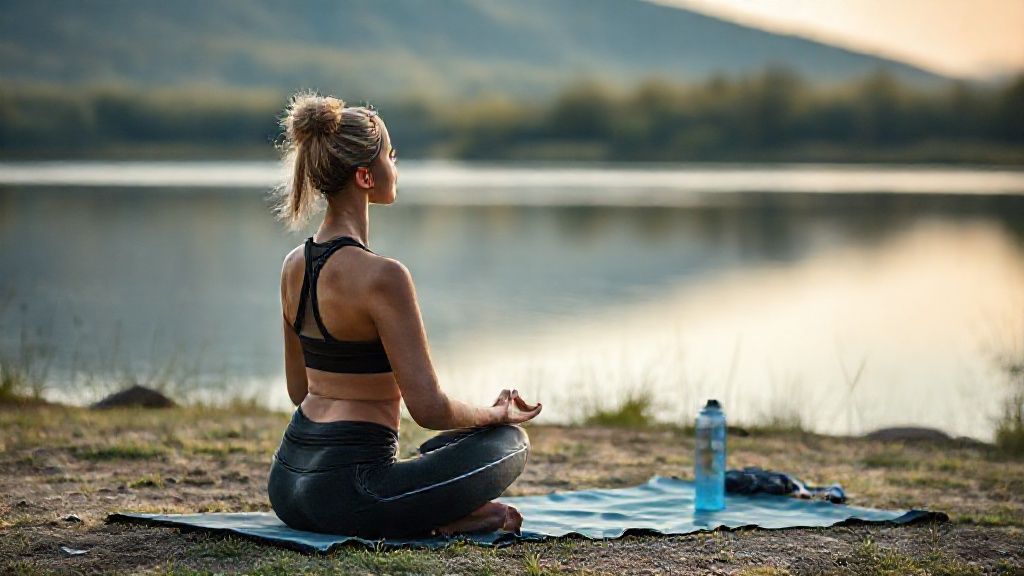
Méditation après l'exercice : Le guide ultime pour apaiser votre corps et votre esprit - Life
You’ve just crushed your workout. Your heart is pounding, your muscles are buzzing, and your mind is still racing with the remnants of adrenaline and effort. But before you rush off to your next task, scroll through your phone, or dive back into your day, there’s a powerful, often-overlooked practice that can amplify your physical gains, speed up your recovery, and bring a profound sense of calm: after exercise meditation.
This isn’t just another item to add to your already-long to-do list. It’s the missing link that transforms a good workout into a holistic ritual for well-being. This guide will teach you exactly how to use post-workout meditation to seamlessly transition from a state of high intensity to one of deep recovery and mental clarity, ensuring you get the most out of every single sweat session.

Why Your Post-Workout Routine is Incomplete Without Meditation
We spend hours perfecting our form, tracking our macros, and pushing our physical limits. Yet, we often neglect the crucial window of time immediately following our workout—a period when our body and mind are uniquely primed for integration and healing. Adding just a few minutes of meditation can be the game-changer that elevates your entire fitness journey.
From Sympathetic to Parasympathetic: Calming Your Nervous System
During intense exercise, your body is in a state of sympathetic nervous system dominance—the famous “fight or flight” mode. Your heart rate is up, cortisol is flowing, and your body is ready for action. While this is essential for performance, lingering in this state post-workout can hinder recovery and keep you feeling jittery and on-edge.
After exercise meditation acts as a deliberate switch, guiding your system into the parasympathetic, or “rest and digest,” state. By focusing on your breath and bodily sensations, you send a direct signal to your brain that the perceived “threat” (the workout) is over. This lowers your heart rate, reduces blood pressure, and initiates the body’s natural repair processes. It’s the conscious cool-down for your nervous system.
Enhance Muscle Recovery and Reduce Inflammation
The benefits aren’t just psychological; they’re physiological. Intense physical activity creates microscopic tears in muscle fibers and triggers inflammatory responses. This is a normal part of building strength, but how quickly you recover depends on your body’s ability to manage this inflammation.
Studies have shown that mindfulness and meditation practices can lead to reduced levels of cortisol, the primary stress hormone that, when chronically elevated, can break down muscle tissue and promote inflammation. Furthermore, the deep relaxation achieved through meditation improves blood flow, delivering oxygen and nutrients more efficiently to fatigued muscles, thereby accelerating the repair process.
Lock in Your Mind-Muscle Connection and Mental Gains
Your workout builds more than just muscle; it builds mental fortitude, discipline, and focus. Meditation provides the space to consolidate these mental gains. By sitting in stillness after pushing your limits, you reinforce the neural pathways associated with perseverance and body awareness.
This practice strengthens the mind-muscle connection, making you more attuned to your body’s signals in future workouts. It also allows you to bask in the accomplishment of your effort, releasing endorphins in a calm, controlled manner rather than crashing from an adrenaline high. This creates a positive feedback loop, making you more likely to view exercise as a rewarding, sustainable practice.
The Perfect 10-Minute After Exercise Meditation Routine
You don’t need a silent retreat or an hour of spare time. This simple, effective 10-minute routine is designed specifically for the post-exercise state. Find a quiet spot, perhaps still on your gym mat or in a peaceful corner at home.
Step 1: Conscious Cool-Down & Body Awareness (2 minutes)
Begin by finding a comfortable seated or even lying down position. Close your eyes. Don’t try to force your breath or clear your mind just yet. Instead, bring your awareness to the physical sensations in your body.
- Notice the residual heat in your muscles.
- Feel your heart rate gradually slowing down.
- Acknowledge any areas of tension or fatigue without judgment.
- Simply scan from the top of your head down to your toes, just observing what’s present.
This initial body scan is a powerful way to transition from external exertion to internal awareness. It grounds you in the present moment and your physical form. For a more structured approach to this practice, you can use our short body scan meditation script.
Step 2: Focused Breathwork to Regulate Heart Rate (3 minutes)
Now, gently guide your attention to your breath. Don’t force it to be deeper or slower than is natural; just observe its current rhythm.
- Place one hand on your chest and the other on your belly.
- Feel the rise and fall of each inhalation and exhalation.
- After a minute of observation, begin to gently lengthen your exhales. Try inhaling for a count of four, and exhaling for a count of six.
- This extended exhale actively stimulates the vagus nerve, a key component of the parasympathetic nervous system, encouraging your body to relax and your heart rate to settle.
This focused breathing is a cornerstone of post-workout recovery. For a deeper dive into various techniques, explore our dedicated 10-minute breathing meditation guide.
Step 3: Guided Visualization for Recovery (5 minutes)
With your body calm and your breath regulated, engage the power of your mind to direct your recovery. This is where you actively participate in the healing process.
- Visualize your breath as a wave of soothing, cool, oxygen-rich energy.
- On each inhale, imagine this energy flowing directly to the muscles that feel the most worked or tired.
- Picture it as a healing light, washing away metabolic waste like lactic acid and delivering vital nutrients for repair.
- See your muscles relaxing, lengthening, and becoming stronger with each breath. You might even visualize them mending the microscopic tears, emerging more resilient than before.
This proactive visualization can have a tangible impact on your recovery mindset and process. For more guided imagery techniques tailored to different goals, check out our library of guided visualization meditations.

Tailoring Your Post-Workout Meditation to Your Needs
Not all workouts are created equal, and neither should your meditation be. You can customize your approach based on the type of exercise you’ve just completed.
For High-Intensity Interval Training (HIIT) or Cardio
After a HIIT session or a long run, your primary challenge is a racing heart and breathlessness. Your meditation should directly address this.
- Focus: Calming the cardiovascular and respiratory systems.
- Technique: Prioritize the breathwork segment (Step 2). Spend more time here, focusing exclusively on elongating your exhales until your breathing feels smooth and controlled. The body scan can be brief, simply acknowledging the high-energy state before gently guiding your focus to the breath.
- Quick Tip: If you’re really short on time or too amped up, even a focused exercice de respiration d’une minute can work wonders to reset your system.
After Strength Training or Weight Lifting
Post-lifting, the sensation is often one of deep muscular fatigue and localized tension.
- Focus: Releasing specific muscle groups and visualizing strength.
- Technique: Emphasize the body scan (Step 1) and visualization (Step 3). During the scan, spend extra time on the muscles you targeted—your quads after squats, your back after rows, etc. Acknowledge the “burn” and then, in the visualization, imagine a feeling of release and expansion in those areas. Visualize the muscle fibers thickening and strengthening.
If You’re Feeling Stressed or Anxious Post-Workout
Sometimes, the mental clutter you hoped to sweat out persists, or the physical stress of exercise can even heighten underlying anxiety.
- Focus: Grounding and emotional regulation.
- Technique: Incorporate a strong grounding element. Before even starting the body scan, feel the points of contact between your body and the floor or mat. Feel the solidity beneath you. If your mind is racing about your day, acknowledge the thoughts and then gently return to the physical sensation of your body being supported. If this is a common experience, a dedicated méditation guidée pour soulager l'anxiété can provide more structured support.
Common Challenges & Quick Fixes
It’s normal to encounter hurdles when starting a new practice. Here’s how to navigate the most common ones.
-
“ Je suis trop surexcité(e) pour rester assis(e) sans bouger. ”
- Solution : Ne forcez pas l'immobilité assise. Essayez plutôt une méditation en marchant. Marchez lentement et en pleine conscience, en coordonnant votre respiration avec vos pas. Vous pouvez également commencer par une brève méditation guidée méditation guidée très engageante, où une voix peut vous aider à ancrer votre attention.
-
“ Je n'ai pas 10 minutes. ”
- Solution : Quelque chose vaut toujours mieux que rien. La mentalité du tout ou rien est le plus grand obstacle. Même 60 secondes de respiration concentrée auront un impact positif sur votre récupération. Engagez-vous dans une pratique plus courte, mais régulière. Notre méditation guidée de 3 minutes méditation de 5 minutes est parfaite pour ces journées surchargées.
-
“ Mon esprit ne cesse de ressasser les événements de ma journée. ”
- Solution : Ce n'est pas un signe d'échec ; c'est tout l'intérêt de la pratique ! Le but n'est pas d'arrêter les pensées, mais de les remarquer et de revenir doucement à votre point d'ancrage (votre respiration ou votre corps). Chaque fois que vous faites cela, vous renforcez votre “ muscle ” de la pleine conscience. Si c'est particulièrement intense, essayez un court script de méditation d'ancrage qui utilise la méthode 5-4-3-2-1 pour engager vos sens.

Questions Fréquemment Posées (FAQ)
Combien de temps dois-je attendre pour méditer après une séance d'entraînement ?
Vous pouvez commencer immédiatement après vos étirements de retour au calme. Il n'est pas nécessaire d'attendre. L'objectif est de passer en douceur de l'activité physique au repos mental, donc profiter de cette fenêtre immédiatement après l'entraînement est idéal.
La méditation peut-elle remplacer mes étirements post-entraînement ?
Non, c'est un complément puissant, pas un remplacement. Les étirements statiques agissent sur l'élasticité et la flexibilité musculaires, tandis que la méditation agit sur la régulation du système nerveux et la récupération mentale. Considérez-la comme un étirement pour votre esprit, ce qui renforce à son tour les bienfaits physiques de vos étirements musculaires.
Et si je m'endors pendant ma méditation ?
C'est tout à fait normal et c'est le signe que votre corps a besoin de repos ! S'endormir signifie que vous avez réussi à activer votre système nerveux parasympathique et permis à votre corps de se détendre vraiment. Si votre objectif est de rester éveillé(e) pour une pratique de pleine conscience, essayez de méditer en position assise plutôt qu'allongé(e).
Quel est le meilleur type de méditation après une séance d'entraînement ?
Le scan corporel, la pleine conscience de la respiration et les visualisations guidées sont les plus efficaces car ils s'adressent directement aux sensations corporelles et au système nerveux. Pour les débutants, une bibliothèque de méditations guidées apaisantes méditation guidée est un excellent point de départ car elle fournit une structure et une direction lorsque votre esprit peut être dispersé.
Conclusion & Appel à l'Action (CTA)
After exercise meditation La méditation post-entraînement est l'arme secrète qui comble le fossé entre l'effort physique et le bien-être holistique. C'est la pratique qui garantit que la discipline et les efforts que vous consacrez à votre entraînement se traduisent par des bienfaits mentaux et physiques durables. En consacrant seulement 10 minutes à ce puissant retour au calme pour votre esprit, vous transformez votre routine d'une simple tâche de fitness en un rituel profond de soin personnel.
Vous terminerez en vous sentant non seulement physiquement épuisé(e), mais aussi mentalement clair(e), émotionnellement équilibré(e) et véritablement récupéré(e).
Prêt(e) à transformer votre récupération et à libérer tout le potentiel de vos entraînements ? Commencez dès aujourd'hui avec la simple routine de 10 minutes décrite ci-dessus. Soyez patient(e) avec vous-même en construisant cette nouvelle habitude. Et si vous êtes nouveau/nouvelle dans la pratique et souhaitez plus de conseils, explorez notre bibliothèque de ressources conçues pour vous aider à construire une habitude de pleine conscience régulière et enrichissante. Vous pouvez commencer par faire le premier pas vers En savoir plus sur la méditation guidée.