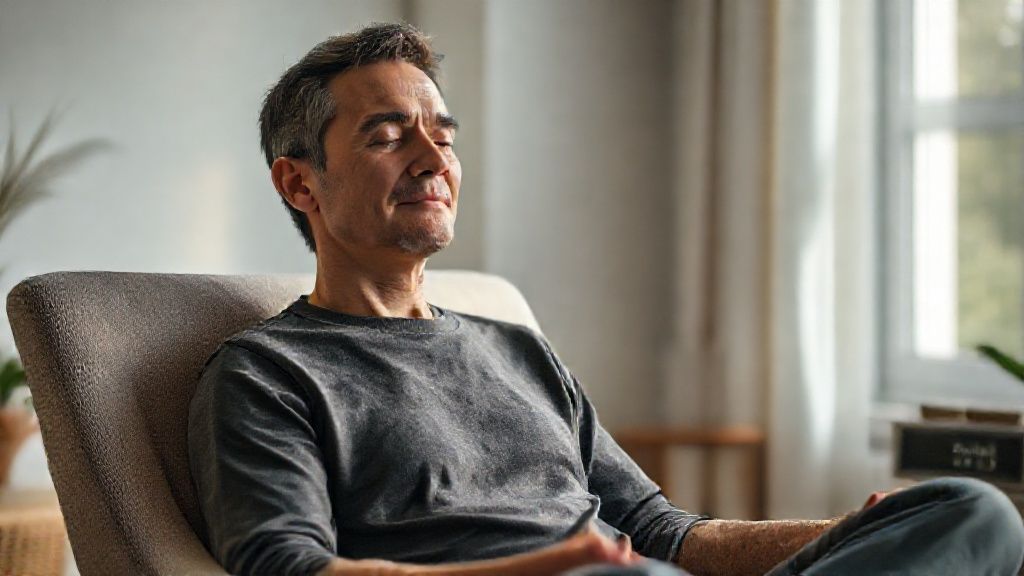
Votre Méditation Apaisante de 10 Minutes : Un Guide Étape par Étape pour une Paix Immédiate
Feeling overwhelmed? That mental to-do list scrolling endlessly through your mind while your shoulders creep up toward your ears? In our constantly connected world, stress can feel like the default setting. You know you “should” meditate, but who has an hour to sit on a cushion? Here’s the secret: you don’t need one.
A 10 minute calming meditation is a powerful, scientifically-backed tool to reset your nervous system, reduce cortisol levels, and find mental clarity. It fits into the time it takes to drink a coffee, scroll through social media, or wait for a meeting to start. This isn’t about achieving enlightenment; it’s about giving your busy brain a much-needed break. This guide provides not just a simple, effective script, but also explains the “why” behind each step, transforming this from a one-off experiment into a sustainable practice that actually sticks.

Why Just 10 Minutes Can Change Your Day
You might wonder if ten minutes is enough to make a real difference. The resounding answer from neuroscience is yes. The benefits of meditation are closely tied to consistency, not just duration. A short, daily practice is far more effective at rewiring neural pathways than a long, sporadic one.
Think of it like physical exercise: doing ten minutes of exercise every day is better for your fitness than a two-hour session once a month. Your brain works the same way. A brief, daily 10 minute calming meditation strengthens the prefrontal cortex (associated with focus and decision-making) and dampens the amygdala (the brain’s fear center). This daily “mental hygiene” creates a baseline of calm that you can access throughout your day, making you more resilient to stressors as they arise. It’s a manageable commitment that builds a powerful, sustainable habit without feeling like a chore.
To understand the foundational principles that make this brief practice so effective, our guide on qu’est-ce que la méditation guidée is a great starting point.
Preparing for Your 10-Minute Practice
Setting yourself up for success takes just a moment. Proper preparation ensures your ten minutes are spent meditating, not fidgeting and getting frustrated.
Finding Your Space
You don’t need a dedicated meditation room. Simply find a relatively quiet spot where you’re unlikely to be interrupted for the next ten minutes. This could be a corner of your bedroom, your office chair before the workday begins, or even your parked car. The goal is to create a small, temporary sanctuary.
Settling Your Posture
Comfort is key. You can sit in a chair with your feet flat on the floor, ensuring your spine is relatively straight but not rigid. Your hands can rest comfortably on your knees or in your lap. If you’re on the floor, cross your legs comfortably. The intention is to be alert yet relaxed—you shouldn’t be fighting physical discomfort during your practice.
Setting a Timer (Or Not)
If you’re using the script below, you can simply read through it. Alternatively, set a gentle, non-jarring timer for ten minutes. Many meditation apps have timers with soft, fading bells. Or, for your first few times, you may prefer to use a guided audio version to lead you through the process without having to keep time.
Your 10-Minute Calming Meditation Script
This is your practical guide. Read through it once to familiarize yourself, then find your space and follow the steps. There is no “right” or “wrong” way to feel—your only job is to follow the instructions gently.
Minutes 1-2: Arriving and Anchoring (The Setup)
- Begin by closing your eyes, or softening your gaze downward.
- Take three deep, intentional breaths. Inhale fully through your nose, and exhale slowly through your mouth with a sigh. With each exhale, feel a release of the tension you’re carrying.
- Now, let your breath return to its natural rhythm. Bring your awareness to the physical sensations of your body. Notice the points of contact: your feet on the floor, your body supported by the chair or cushion. Feel the weight of your hands resting. You are arriving, right here, right now.
Minutes 3-7: The Body Scan for Deep Relaxation (The Core Practice)
- Bring your attention to the top of your head. Simply notice any sensations there—tingling, warmth, or perhaps nothing at all. There’s no need to change anything.
- Slowly, gently, guide your awareness down through your body. Move to your forehead, your eyes, your jaw. Consciously release any tension you find. Let your jaw hang slack.
- Continue scanning down through your neck and shoulders. These are common storage spots for stress. As you breathe in, imagine sending your breath to this area. As you breathe out, visualize the tension melting away.
- Move down through your arms, into your hands and fingers. Then, bring your awareness to your chest and stomach, noticing the gentle rise and fall with each breath.
- Finally, scan down through your lower back, hips, thighs, knees, calves, ankles, and all the way to the soles of your feet. Spend a full minute just resting your awareness in your feet, feeling their connection to the ground.
If you enjoy this body-focused approach to relaxation, you can explore a shorter version with our script de scan corporel de 5 minutes. For a body scan designed specifically to prepare your body for deep rest, delve into our méditation par balayage corporel pour le sommeil.

Minutes 8-9: Focusing on the Breath (Calming the Mind)
- Now, let your awareness settle on your natural breath. You don’t need to force or control it. Simply notice the physical sensations of breathing.
- Choose an anchor point: the cool air entering your nostrils, the rise and fall of your chest, or the expansion and contraction of your belly.
- Keep your attention on this single point. This is your home base. Your mind va wander—this is completely normal and expected. When you notice it has drifted into thought, planning, or worrying, gently and kindly guide it back to the sensation of the breath. No scolding, no frustration. Each return is a repetition of your mental workout.
If you find your mind is particularly busy and you need a tool to use in the moment, this quick breathing exercise is a perfect anchor to use anytime, anywhere.
Minute 10: Expanding Awareness and Gently Closing (The Integration)
- Gently release your focused attention on the breath.
- Expand your awareness to include your entire body once again. Feel the whole body sitting here, breathing. Notice the space around you.
- Begin to bring back awareness of the physical room. Listen for the faintest sounds around you. Notice the temperature of the air on your skin.
- Slowly, when you feel ready, begin to deepen your breath. Gently wiggle your fingers and toes, bringing movement back into the body.
- Open your eyes when you are ready. Take a final, mindful moment to notice how you feel before you gently rise and continue with your day.
What to Do When Your Mind Wanders
This is perhaps the most important section. A wandering mind is not a sign of failure; it is the entire point of the practice. The magic isn’t in having an empty mind; it’s in the moment you realize your mind has wandered. That moment of awareness is the rep—the mental bicep curl.
When you notice you’re lost in thought, simply acknowledge it. You can even silently label it (“thinking,” “planning,” “worrying”) and then gently escort your attention back to your breath or body. Do this with kindness, as you would guide a child who has wandered off. Judging yourself for having thoughts only adds a second layer of suffering. The practice is the gentle return, again and again.
Développer ce ‘ muscle de la prise de conscience ’ est un élément central de la pleine conscience. Découvrez des moyens plus pratiques d’intégrer cette compétence dans votre vie quotidienne avec ces exercices de pleine conscience rapides.
Approfondir votre pratique de l'apaisement
Une fois que cela 10 minute calming meditation devient un ami familier, vous pourriez souhaiter explorer d’autres pratiques adaptées à des besoins spécifiques.
Pour les moments de forte anxiété
Lorsque le niveau de stress monte en flèche, avoir une pratique ciblée peut être une bouée de sauvetage. Si vous faites face à une inquiétude intense ou à une réaction de panique, notre méditation de 10 minutes pour l'anxiété dédié peut apporter un soulagement immédiat en se concentrant sur l’ancrage et la sécurité. Pour une séance plus longue et approfondie afin de traiter un stress plus profond, essayez ce méditation guidée pour le stress et l'anxiété.
Pour une nuit de sommeil paisible
Le calme que vous cultivez peut être canalisé sans effort vers le repos. Transformez votre pratique du soir en une porte d’entrée vers un repos profond avec notre méditation de sommeil de 10 minutes, conçue spécifiquement pour préparer votre corps et votre esprit à une nuit de sommeil réparateur.
Explorer différents styles de méditation
Le monde de la pleine conscience est vaste et varié. Si vous constatez que vous appréciez la pratique et avez un peu plus de temps, une méditation guidée de 15 minutes permet une exploration plus profonde et une période d’installation plus longue. Ou, expérimentez une technique différente et un guidage vocal avec ce bibliothèque de méditations guidées apaisantes.

Questions Fréquemment Posées (FAQ)
Q : 10 minutes de méditation, est-ce vraiment suffisant ?
R : Absolument. Les neurosciences confirment que la régularité prime sur la durée. Une pratique quotidienne de dix minutes crée des voies neuronales plus solides pour le calme et la concentration qu’une pratique plus longue mais irrégulière. Il s’agit de construire une habitude durable.
Q : Je n’arrête pas de penser pendant la méditation. Est-ce que je m’y prends mal ?
R : Non, vous vous y prenez bien ! Le but n’est pas d’arrêter les pensées, mais de changer votre relation avec elles. La pratique réside dans l’acte doux de remarquer que vous êtes en train de penser et de ramener votre attention sans jugement. C’est l’exercice fondamental de la pleine conscience.
Q : Quel est le meilleur moment de la journée pour une méditation apaisante ?
R : Tous les moments sont bons. Beaucoup de gens trouvent qu’une pratique matinale donne un ton positif et centré à la journée. D’autres l’utilisent comme une “ parenthèse ” pour sortir du mode travail le soir. Expérimentez pour voir ce qui correspond à votre rythme.
Q : Puis-je utiliser de la musique avec cette méditation ?
R : Certainement. Si le silence est puissant, une musique apaisante ou des sons d’ambiance peuvent aider à masquer les bruits de fond et à approfondir la relaxation. Vous pouvez utiliser notre musiques de méditation de 10 minutes piste dédiée comme toile de parfaite pour ce script.
Conclusion & Appel à l'Action (CTA)
Vous détenez désormais un outil simple et puissant pour gérer le stress et cultiver la paix intérieure. Le seuil d’entrée est bas – juste dix minutes et la volonté d’être bienveillant envers votre propre esprit. Cette 10 minute calming meditation est votre bouton de réinitialisation accessible et toujours disponible.
Rappelez-vous, la perfection n’est pas le but ; le fait de s’y mettre l’est. Certains jours, votre esprit semblera calme, d’autres jours, il sera un tourbillon. Les deux sont des expériences valables et précieuses. L’effet cumulatif de ce petit investissement quotidien est profond : une plus grande résilience émotionnelle, une concentration améliorée et un sentiment de calme profond et durable que vous pouvez emporter partout avec vous.
Prêt à faire du calme une habitude quotidienne ? Ajoutez cette page à vos favoris et essayez le script ci-dessus dès maintenant. Ne réfléchissez pas trop – commencez simplement. Votre futur moi, plus calme, vous remerciera.