Your 15 Minute Guided Meditation: A Step-by-Step Guide to Find Calm & Clarity
In our fast-paced world, finding moments of peace can feel like a luxury we can’t afford. Yet what if you could reset your entire nervous system, reduce stress, and improve your focus in just 15 minutes? That’s precisely the power of a 15-minute guided meditation—the perfect balance between accessibility and effectiveness. This sweet-spot duration gives your mind enough time to transition from frantic “doing” mode to peaceful “being” mode, creating tangible benefits that ripple throughout your day. Whether you’re a seasoned practitioner or completely new to meditation, this comprehensive guide will show you exactly how to make those 15 minutes count, complete with a practical script and tailored approaches for your specific needs.

Why a 15 Minute Meditation is Your Sweet Spot
When it comes to meditation, many people assume that longer is always better. While extended sessions have their place, research and practical experience show that 15 minutes hits the perfect balance for most people’s lives and needs.
The Science of Settling In
Your brain doesn’t instantly switch from busy thinking to quiet awareness—it needs a transition period. Neuroscientific studies using fMRI scans show that it typically takes 5-8 minutes for the brain to move from beta waves (associated with active thinking) to alpha waves (linked to relaxed awareness). A 15-minute session gives you this crucial settling-in period plus several minutes of sustained alpha and even theta wave activity, which is associated with deep meditation, creativity, and insight.
The physiological benefits are equally impressive. Just 15 minutes of meditation can:
– Lower cortisol levels (the stress hormone)
– Reduce blood pressure
– Decrease heart rate
– Improve heart rate variability (a marker of resilience)
Achievable for Busy Schedules
The biggest obstacle to maintaining a meditation practice isn’t willingness—it’s consistency. While aspiring to hour-long sessions might sound impressive, it’s often unsustainable for people with jobs, families, and responsibilities. A 15-minute commitment is far more manageable, making it easier to build into your daily routine.
Think about it: 15 minutes is less time than you might spend scrolling through social media, waiting in line for coffee, or watching half an episode of a TV show. By framing it as an achievable daily habit rather than a monumental time commitment, you’re far more likely to stick with it long enough to experience the cumulative benefits.
For those just starting out, a shorter practice can be a great foundation. Try our 5 minute guided meditation for beginners to build your confidence before moving to longer sessions.
What to Expect in Your First 15 Minute Session
If you’re new to meditation, knowing what to expect can ease anxiety and help you approach your practice with greater comfort and confidence.
Finding a Comfortable Posture
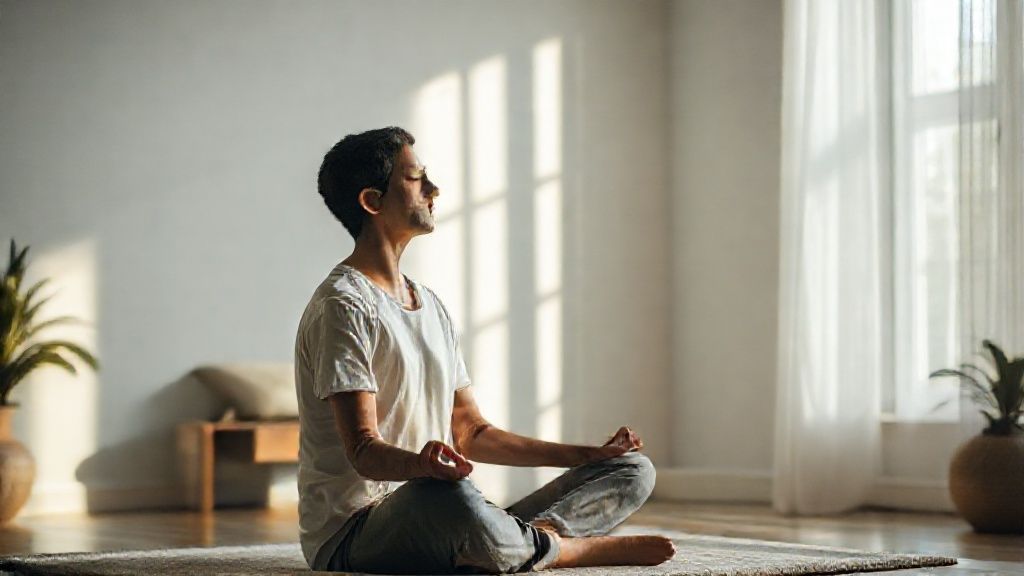
Contrary to popular imagery, you don’t need to sit in a perfect lotus position to meditate effectively. The key is finding a posture that allows you to be both alert and relaxed. You can:
– Sit in a chair with your feet flat on the floor
– Use a meditation cushion or bench
– Kneel with support
– Even lie down if sitting is uncomfortable (though you might be more prone to falling asleep)
The important elements are keeping your spine relatively straight (imagine a string gently pulling the crown of your head upward) and positioning yourself so you can breathe freely without slouching.
The Role of the Guide’s Voice
In guided meditation, the instructor’s voice serves as an anchor for your attention. Rather than fighting to maintain focus on your own, you can gently return your attention to the guide’s instructions whenever your mind wanders. Don’t worry if you find some voices more soothing or effective than others—this is completely normal. The right guide voice is subjective, so feel free to explore different instructors until you find one that resonates with you.
Dealing with a Wandering Mind (This is normal!)
Perhaps the most important expectation to set is that your mind will wander—frequently. This isn’t a sign that you’re “bad at meditation” but rather evidence that you have a normally functioning brain. The practice isn’t about stopping thoughts entirely but about noticing when you’ve become distracted and gently returning your attention without self-judgment.
Each time you notice your mind has wandered and bring it back to the meditation, you’re actually strengthening your “attention muscle”—this is the core of the practice. Be patient with yourself, especially in the beginning.
A Sample 15 Minute Guided Meditation Script
Here’s a complete script you can use right now for your meditation practice. You can read it through first, record yourself reading it, or simply have it nearby as a reference during your session.
Introduction & Settling (2 minutes)
“Find a comfortable seated position, either in a chair or on a cushion on the floor. Allow your hands to rest comfortably on your lap or knees. Gently close your eyes or lower your gaze. Begin by bringing awareness to your body in space. Notice the points of contact—your feet on the floor, your sitting bones on the chair or cushion, your hands resting. Take three deep breaths, inhaling fully and exhaling completely. With each exhale, consciously release any obvious tension you’re holding. There’s nowhere else you need to be, nothing else you need to be doing in this moment. Give yourself permission to be fully present here and now.”
Body Scan for Awareness (5 minutes)
“Bring your attention to the top of your head. Simply notice any sensations here—tingling, warmth, coolness, or perhaps no distinct sensation at all. That’s perfectly fine. Slowly move your awareness down through your forehead… around your eyes… your cheeks and jaw. Consciously relax your jaw, allowing your teeth to separate slightly. Continue down to your neck and shoulders… noticing and releasing any tension held here. Move your awareness down through your arms to your hands and fingertips. Then to your chest and upper back… your abdomen and lower back… down through your hips… thighs… knees… calves… ankles… feet… and all the way to your toes. Spend a few moments feeling your body as a complete whole, alive and breathing.”
Focus on the Breath (5 minutes)
“Now gently bring your attention to your natural breath. Don’t try to change it or control it—simply observe it as it is. Notice where you feel the breath most distinctly—perhaps at the nostrils, the chest, or the rising and falling of your abdomen. Choose one of these places and rest your awareness there. When your mind wanders—which it will, countless times—gently note where it went, then without judgment, return your attention to the breath. Each return is a moment of mindfulness, a small victory in your practice. If it helps, you can mentally note ‘in’ on the inhalation and ‘out’ on the exhalation. Continue following the natural rhythm of your breath.”
Gentle Return & Closing (3 minutes)
“Slowly expand your awareness from the breath to include your entire body once again. Notice any sounds in the environment, the temperature of the air on your skin. Gently begin to reintroduce small movements—wiggling your fingers and toes, rotating your ankles and wrists. When you feel ready, slowly open your eyes if they’ve been closed. Take a moment to notice how you feel—perhaps more relaxed, more present, more grounded. Carry this quality of awareness with you as you transition back into your day. Know that you can return to this place of calm whenever you need throughout your day.”
If you’d like to explore different script styles, we have a library of resources. Check out our guided meditation script for relaxation for variations on this practice.

Tailoring Your 15 Minute Practice to Your Needs
While the basic structure of meditation remains consistent, you can subtly shift the focus of your practice to address specific needs and challenges.
For Deep Relaxation and Stress Relief
When stress relief is your primary goal, emphasize elements that activate the parasympathetic nervous system (your “rest and digest” mode). In your practice:
– Spend extra time on the body scan, consciously relaxing each muscle group
– Use longer exhalations (which naturally calm the nervous system)
– Incorporate visualization—imagining yourself in a peaceful, safe place
– Use calming mantras like “I am calm” or “I release tension” synchronized with your breath
To extend your relaxation practice, you might enjoy our 10 minute calming meditation for days when you need a quick reset.
For Overcoming Anxiety and Overthinking
Anxiety often involves being trapped in future-oriented thinking. Meditation for anxiety should gently anchor you in the present moment and your body. Try:
– Focusing strongly on physical sensations (the weight of your body, the feeling of air on skin)
– Noting practices where you mentally label thoughts as “thinking” before returning to the breath
– Counting breaths (1-10 then starting over) to give your thinking mind a simple task
– Incorporating grounding phrases like “In this moment, I am safe” or “This too shall pass”
If anxiety is particularly high, a shorter, more focused session can help. Try this 10 minute guided meditation for anxiety. For a deeper dive, explore our 20 minute meditation for anxiety when you have more time to work with intense feelings.
For a Restful Night’s Sleep
When meditating for sleep, the approach shifts slightly—the goal is to ease the transition into sleep rather than maintain alert awareness. For bedtime meditation:
– Practice lying down in your bed
– Use longer exhalations to activate the relaxation response
– Incorporate progressive muscle relaxation (tensing and releasing muscle groups)
– Visualize calming, sleep-inducing imagery (floating on clouds, sinking into a comfortable bed)
– Don’t worry if you fall asleep during the practice—that’s the goal!
To transition directly into sleep, a dedicated bedtime meditation is ideal. Discover our most effective διαλογισμός πριν τον ύπνο. designed specifically for the pre-sleep window.
Enhancing Your Meditation Journey
A strong meditation practice is supported by knowledge, community, and sometimes, helpful tools. Here’s how to deepen and enrich your experience.
The Best Apps to Guide You
While this guide provides everything you need to start, meditation apps can offer variety, structure, and convenience. The best apps provide:
– A variety of guide voices and styles
– Different session lengths for different needs
– Progress tracking to maintain motivation
– Specific programs for goals like stress reduction, focus, or sleep
For a curated list of digital tools, check out our review of the best meditation apps like Headspace to find the perfect digital companion for your practice.
Understanding Guided Meditation
If you’re new to the practice, you might wonder how simply listening to someone talk can create such profound changes. Guided meditation works by:
– Providing an external focus point, reducing the mental effort required
– Offering skillful instructions that direct your attention in specific ways
– Using language and pacing that naturally calm the nervous system
– Helping you navigate common challenges (like wandering thoughts) in real-time
New to the concept? Learn more about τι είναι η καθοδηγούμενη διαλογισμός and how it works to transform your relationship with your mind.

Συχνές Ερωτήσεις (FAQ)
Q: Is 15 minutes of meditation enough?
A: Yes, consistency is more important than duration. 15 minutes daily is highly effective for building resilience and focus. Research shows that regular meditation creates structural changes in the brain associated with emotional regulation and attention, and these benefits are achievable with just 15 minutes per day. The key is daily practice rather than occasional longer sessions.
Q: What’s the difference between a 10-minute and a 15-minute meditation?
A: A 15-minute session allows more time to move beyond initial settling into a deeper state of calm, whereas a 10-minute meditation is excellent for a quick reset. The extra five minutes in a 15-minute session typically provides additional time for sustained focused attention, which can lead to more noticeable benefits in stress reduction and mental clarity. Explore our 10 minute mindfulness practice to compare experiences and find what works best for different situations.
Q: Can I use meditation music instead of a guide?
A: Absolutely. Guided sessions are for focus, while music is for ambiance. Guided meditation is particularly helpful when you’re learning or when your mind is especially busy, as the verbal instructions provide direction. Meditation music can be wonderful for creating a peaceful atmosphere and supporting self-directed practice. Many people alternate between both depending on their needs. For a pure auditory experience, try our 10 minute meditation music tracks designed to enhance your practice.
Conclusion
Your journey to a calmer mind is truly just 15 minutes away. This accessible yet powerful practice length offers the perfect balance between fitting into a busy schedule and creating meaningful change in your mental and emotional wellbeing. Remember that meditation is a skill that develops with practice—each session builds upon the last, regardless of how “successful” it felt in the moment.
Whether you use the script provided above or explore our library of guided sessions, the most important step is simply to begin. Don’t wait for the perfect time, the perfect cushion, or the perfect quiet—start where you are, with what you have. The cumulative benefits of regular practice—increased focus, emotional resilience, and inner peace—are well worth the small daily investment.
Ready to try another length? Discover our complete range of σύντομους καθοδηγούμενους διαλογισμούς tailored for every need and moment. From quick 5-minute resets to deeper 20-minute explorations, you’ll find the perfect practice to support your wellbeing journey.