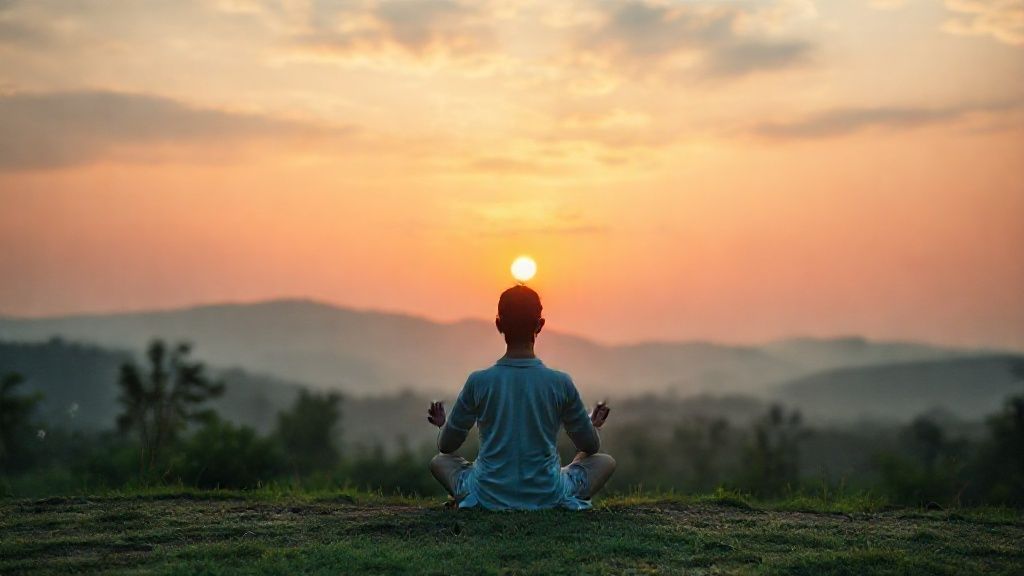
Buddhismus und Achtsamkeitsmeditation: Ein Anfängerweg zum inneren Frieden
In our fast-paced, constantly connected world, feelings of stress, anxiety, and overwhelm have become almost universal. As we scroll through endless notifications, juggle multiple responsibilities, and navigate complex relationships, many of us find ourselves searching for an anchor—a way to quiet the mental chatter and find a sense of calm amidst the chaos. This search often leads people to mindfulness meditation, a practice that has gained tremendous popularity in recent years. But what many don’t realize is that this powerful tool for mental well-being has deep roots in ancient Buddhist teachings that date back over 2,500 years.
Mindfulness meditation is a core practice derived from ancient Buddhist teachings, designed to cultivate present-moment awareness and reduce suffering. This guide will explore its origins, core principles, and how you can start practicing today.
Whether you’re completely new to meditation or have dabbled in mindfulness apps, understanding the Buddhist foundation of this practice can transform your approach and deepen your experience. In this comprehensive guide, we’ll journey from the ancient teachings of the Buddha to practical techniques you can incorporate into your modern life.
What Is the Buddhist Root of Modern Mindfulness?
The mindfulness revolution sweeping through corporations, schools, and healthcare settings didn’t emerge from a vacuum. Its origins can be traced directly to the Satipatthana Sutta, one of the most important discourses in the Pali Canon—the earliest collection of Buddhist teachings. In this foundational text, the Buddha laid out the “Four Foundations of Mindfulness,” a comprehensive system for developing awareness of body, feelings, mind, and mental objects.
The Pali word “Sati,” which we translate as “mindfulness,” carries a richer meaning than its English counterpart. Sati implies not just awareness but remembrance—remembering to pay attention to our present-moment experience with clarity and precision. This isn’t a passive state of zoning out but an active, engaged process of noticing what’s happening right here, right now.
There’s an important distinction between modern secular mindfulness and its traditional Buddhist context. Today, mindfulness is often presented as a tool for stress reduction, productivity enhancement, or emotional regulation. While these benefits are real and valuable, traditional Buddhist mindfulness serves a more profound purpose: it’s a path to enlightenment and the end of suffering (Dukkha). The ultimate goal isn’t just to feel better temporarily but to see reality clearly and free oneself from the root causes of mental distress.
For those completely new to meditation practices, understanding was geführte Meditation ist can provide an accessible entry point to these ancient techniques. Guided sessions offer structure and direction, making it easier to establish a consistent practice that honors both the traditional roots and modern applications of mindfulness.

Core Buddhist Principles That Power Mindfulness
To truly understand mindfulness meditation beyond a surface level, it helps to explore the key Buddhist principles that give the practice its depth and transformative power. These concepts aren’t just philosophical ideas—they’re insights into the nature of reality that we can directly experience through mindful awareness.
Understanding Impermanence (Anicca)
The Buddha identified impermanence as one of the three fundamental characteristics of existence. Everything—from our thoughts and emotions to our physical bodies and the world around us—is in a constant state of flux. Nothing remains the same from one moment to the next.
When we practice mindfulness meditation, we’re not just watching our breath; we’re observing the continuous flow of sensations, thoughts, and feelings. We notice how a sound arises and passes away, how an itch appears and disappears, how a thought emerges and vanishes. This direct experience of impermanence helps us develop a more flexible relationship with our experiences. Instead of clinging to pleasant moments or resisting unpleasant ones, we learn to meet each experience with openness, knowing it will inevitably change.
The Concept of “No-Self” (Anatta)
Perhaps the most challenging Buddhist concept for Western minds is Anatta, often translated as “no-self” or “non-self.” This doesn’t mean that we don’t exist at all, but that what we typically consider our “self”—a solid, permanent, independent entity—is actually a collection of ever-changing physical and mental processes.
Through mindfulness practice, we begin to de-identify from our thoughts and emotions. Instead of thinking “I am angry,” we learn to notice “there is anger present.” This subtle shift in perspective creates space between our awareness and our experiences, reducing ego-driven reactions and providing greater freedom in how we respond to life’s challenges.
The End of Suffering (Dukkha)
The Buddha’s primary teaching was about the nature of suffering and the path to its end. Dukkha is often translated as “suffering,” but it encompasses a broader range of experiences including stress, dissatisfaction, and the inherent unsatisfactoriness of conditioned existence.
Mindfulness addresses suffering not by trying to eliminate unpleasant experiences, but by changing our relationship to them. When we observe our cravings and aversions without judgment—simply noting “wanting” or “resistance” as they arise—we stop feeding the patterns that create mental suffering. This approach is beautifully supported by practices like a letting go meditation script, which provides specific guidance for working skillfully with attachment and resistance.
The Profound Benefits of a Buddhist Mindfulness Practice
While the ultimate goal of traditional Buddhist practice extends beyond temporary relief, the benefits of mindfulness meditation are both immediate and cumulative. By committing to regular practice, you can experience positive changes in multiple dimensions of your life.
Reducing Anxiety and Quieting the Mind
Anxiety often thrives on our tendency to get caught in loops of negative thinking—rehashing past events or worrying about future possibilities. Mindfulness interrupts this pattern by anchoring our attention in the present moment, typically using the breath as a home base.
Research has shown that regular mindfulness practice can reduce activity in the amygdala (the brain’s fear center) while strengthening connections to the prefrontal cortex (responsible for rational thinking and emotional regulation). This neural rewiring translates to practical benefits: you may find yourself less reactive to stressors, better able to pause before responding, and more capable of navigating challenging situations with clarity.
For those moments when anxiety feels overwhelming, having specific tools can make all the difference. A 10-minute meditation for anxiety offers a manageable practice for stressful times, while a more comprehensive geführte Meditation bei Stress und Angst can provide deeper support when you need extended relief.
Cultivating Compassion for Yourself and Others
As mindfulness deepens, it naturally gives rise to greater compassion. When we see our own struggles clearly—our patterns, vulnerabilities, and shared humanity—we develop more kindness toward ourselves. This self-compassion then extends outward to others, as we recognize that everyone is navigating their own challenges.
This natural progression is formally cultivated in Buddhist practice through Metta (Loving-Kindness) meditation, which involves systematically directing well-wishes toward ourselves and others. Rather than being a separate practice, Metta is understood as a natural expression of mindful awareness—when we see clearly, we respond with compassion.
If you’re interested in exploring this dimension of practice, a guided Metta (loving-kindness) meditation script can help you develop this quality of open-hearted awareness.

How to Start Your Buddhist-Inspired Mindfulness Practice Today
The beauty of mindfulness is that it doesn’t require special equipment, extensive training, or perfect conditions. You can begin right where you are, with the resources you already have. Here’s a practical framework for establishing your practice.
Posture and Environment: Setting the Foundation
While you can practice mindfulness anywhere, creating a supportive environment can help strengthen your commitment, especially when starting out.
- Posture: The traditional meditation posture balances dignity and relaxation. If sitting on the floor, use a cushion to raise your hips slightly above your knees. If using a chair, sit forward rather than leaning back. Keep your spine upright but not rigid, shoulders relaxed, hands resting comfortably on your knees or lap. The goal isn’t to create tension but to cultivate alert relaxation.
- Environment: Choose a relatively quiet space where you’re unlikely to be interrupted. You might create a simple meditation corner with a cushion or chair. While complete silence isn’t necessary (and can be another form of attachment), minimizing major distractions supports early practice.
A Simple 5-Minute Breathing Mindfulness Meditation
This foundational practice follows the Buddha’s instructions for mindfulness of breathing. Start with just five minutes daily—consistency matters more than duration, especially when beginning.
- Set Your Intention: Begin by recognizing your motivation—perhaps to cultivate peace, clarity, or kindness.
- Establish Posture: Sit in your chosen posture, allowing your body to settle.
- Notice Natural Breath: Bring attention to the physical sensations of breathing—the movement of your abdomen, the air passing through your nostrils. There’s no need to control or change your breath.
- Anchor Attention: Use the breath as an anchor for your attention. When your mind wanders (which it will, repeatedly), gently note where it went and return to the breath without judgment.
- Expand Awareness: After focusing on the breath, briefly expand awareness to include sounds, bodily sensations, and thoughts—simply noticing whatever arises.
- Close with Kindness: Conclude by bringing a moment of appreciation for your effort, regardless of how “successful” the session felt.
For additional support, you might try a simple 5-minute guided meditation when starting out, or use a 10-minute breathing meditation script once you’re ready to extend your practice.
Achtsamkeit in den Alltag integrieren
Formelle Meditation ist wie ein Besuch im Fitnessstudio für den Geist, doch die wahren Vorteile entfalten sich, wenn Sie achtsame Bewusstheit in Ihre täglichen Aktivitäten einbringen.
- Achtsames Essen: Nehmen Sie eine Mahlzeit pro Tag ohne Ablenkungen ein. Achten Sie auf die Farben, Texturen, Gerüche und Aromen Ihres Essens. Kauen Sie langsam und legen Sie das Besteck zwischen den Bissen ab.
- Achtsames Gehen: Achten Sie beim Gehen auf die körperlichen Empfindungen in Ihren Füßen und Beinen – das Anheben, Bewegen und Aufsetzen jedes Fußes.
- Achtsames Zuhören: Üben Sie in Gesprächen, der anderen Person Ihre volle Aufmerksamkeit zu schenken, ohne bereits Ihre Antwort zu planen, während sie spricht.
Ihre Praxis vertiefen: Nächste Schritte auf dem Weg
Mit fortschreitender Achtsamkeitspraxis verspüren Sie vielleicht den Wunsch, verschiedene Techniken zu erkunden und Gemeinschaftsunterstützung zu finden. Diese natürliche Entwicklung spiegelt den umfassenden Pfad wider, den der Buddha für die spirituelle Entwicklung skizzierte.
Verschiedene Meditationstechniken erkunden
Während die Achtsamkeit des Atems eine solide Grundlage bietet, hält die buddhistische Tradition eine reiche Vielfalt an Meditationspraktiken bereit, die darauf ausgelegt sind, verschiedene geistige Qualitäten zu entwickeln.
- Body-Scan-Meditation: Diese Praxis beinhaltet die systematische Lenkung der Aufmerksamkeit durch verschiedene Körperteile, um ein detailliertes Bewusstsein für körperliche Empfindungen zu kultivieren. Sie ist besonders hilfreich für die Entwicklung von Konzentration und den Umgang mit Schmerz oder Unbehagen. Eine Bodyscan-Meditation für Schlaf und Entspannung kann besonders vorteilhaft für diejenigen sein, die mit Schlaflosigkeit oder körperlicher Anspannung kämpfen.
- Gehmeditation: Statt ein Mittel zu sein, um von A nach B zu gelangen, wird die Gehmeditation zur Praxis selbst – indem sie das volle Bewusstsein auf die Erfahrung des Sich-durch-den-Raum-Bewegens lenkt.
- Metta-Meditation (Liebevolle-Güte-Meditation): Wie bereits erwähnt, kultiviert diese Praxis gezielt bedingungslose Freundlichkeit uns selbst und anderen gegenüber.
Gemeinschaft und vertiefendes Lernen finden
Während die persönliche Praxis wesentlich ist, hat die buddhistische Tradition stets die Bedeutung der spirituellen Gemeinschaft (Sangha) betont. Der Kontakt mit anderen auf dem Weg kann Inspiration, Unterstützung und wertvolle Führung bieten.
Wenn Sie daran interessiert sind, persönliche Möglichkeiten zu erkunden, könnten Sie Meditationszentren in Ihrer Nähe finden, die Kurse oder Gruppensitzungen anbieten. Für diejenigen mit begrenzten lokalen Optionen oder vollen Terminkalendern, erkunden Sie Online-Meditationskurse, die strukturiertes Lernen von qualifizierten Lehrern bieten.

eine einfache einminütige Atemübung
F: Ist Buddhismus und Achtsamkeitsmeditation eine Religion?
A: Obwohl ihre Wurzeln im Buddhismus liegen, ist die Praxis der Achtsamkeit selbst eine mentale Trainingstechnik, die von jedem unabhängig von der religiösen Überzeugung genutzt werden kann. Sie können von Achtsamkeitsmeditation profitieren, ob Sie Buddhist, Christ, Jude, Muslim, Hindu, Atheist oder Agnostiker sind.
F: Was ist der Unterschied zwischen Achtsamkeit und bloßer Entspannung?
A: Entspannung ist oft ein Nebenprodukt, doch Achtsamkeit geht um zweckgerichtetes, nicht-wertendes Gewahrsein. Es geht darum, präsent zu sein für das, was auftaucht, angenehm oder unangenehm. Für eine Praxis, die rein auf Ruhe abzielt, probieren Sie diese geführte Meditation für einen ruhigen Geist..
F: Wie lange dauert es, bis man Vorteile von Achtsamkeitsmeditation bemerkt?
A: Vorteile wie Ruhe können unmittelbar gespürt werden, doch dauerhafte Veränderungen in der Gehirnstruktur und den Reaktionsmustern werden durch konsequente, tägliche Praxis unterstützt. Fangen Sie klein an mit einer kurze geführte Meditation und konzentrieren Sie sich darauf, die Gewohnheit aufzubauen, anstatt bestimmte Ergebnisse zu erreichen.
Fazit & Handlungsaufforderung (CTA)
Die Reise von den alten buddhistischen Lehren zu modernen Achtsamkeitspraktiken stellt eine bemerkenswerte Brücke zwischen Weisheitstraditionen und zeitgenössischer Wissenschaft dar. Was in Indien als Weg zur Erleuchtung begann, hat sich zu einem evidenzbasierten Ansatz für mentales Wohlbefinden entwickelt, der Menschen aller Hintergründe und Glaubensrichtungen zugänglich ist.
Das Wesen dieser Praxis bleibt einfach, wenn auch nicht immer leicht: Unserem Leben, so wie es ist, vollständig zu begegnen – mit Offenheit, Neugier und Mitgefühl. Ob Sie fünf Minuten oder fünfzig haben, ob Sie auf einem Kissen oder Ihrem Bürostuhl sitzen, die Einladung ist dieselbe – innezuhalten, zu atmen und sich daran zu erinnern, dass dieses gegenwärtige Moment der Ort ist, an dem das Leben tatsächlich stattfindet.
Der Weg der Achtsamkeit geht nicht darum, einen perfekten Zustand der Ruhe zu erreichen oder alle Schwierigkeiten zu beseitigen. Es geht darum, Ihre Beziehung zu Ihren Erfahrungen zu verändern – mehr Raum, mehr Wahlmöglichkeit und mehr Freiheit genau inmitten dieses chaotischen, wunderschönen menschlichen Lebens zu finden.
Bereit, vom Lesen zum Erleben überzugehen? Beginnen Sie Ihre Reise gleich jetzt mit unserer beliebtesten Sitzung für Anfänger. Beginnen Sie hier mit unserer besten geführten Meditation für Anfänger.
