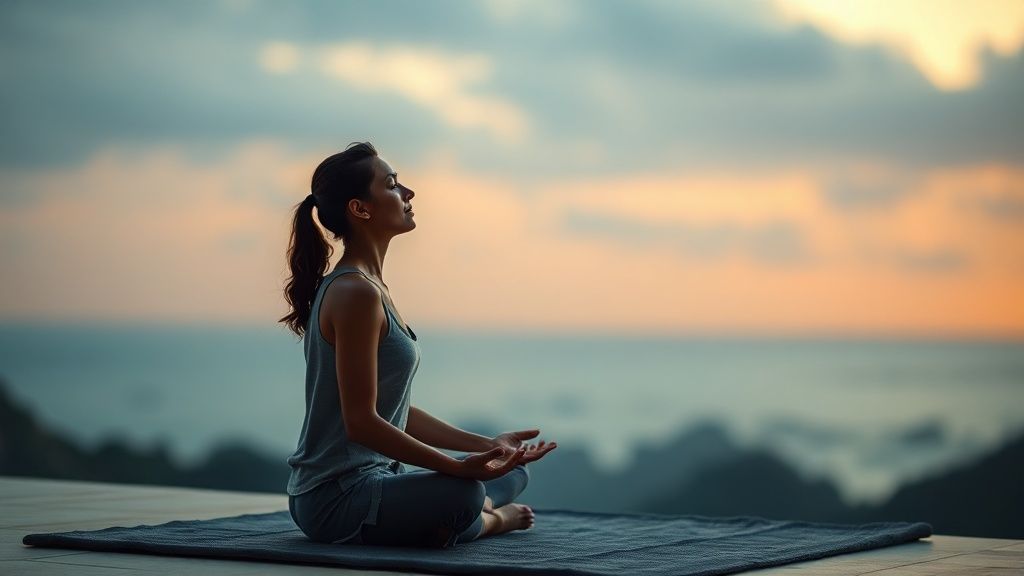
Muscle Relaxation Exercises: A Step-by-Step Guide to Release Tension & Stress
If you’re searching for effective muscle relaxation exercises, you’re likely feeling the physical effects of stress, whether it’s a tight neck, sore shoulders, or general restlessness. That persistent ache in your shoulders after a long day, the clenched jaw you notice during a stressful meeting, or the overall stiffness that makes it hard to unwind—these are all signs that your body is holding onto tension. Muscle relaxation is a proven technique to calm your nervous system and release built-up tension. This definitive guide will walk you through the most effective exercises, from quick fixes to deep relaxation techniques, helping you find calm and improve your sleep.

Why Muscle Relaxation Is Your Secret Weapon Against Stress
In our fast-paced world, stress has become a constant companion for many. What we often fail to recognize is how profoundly mental and emotional stress manifests in our physical bodies. Understanding this connection is the first step toward effective relief.
The Mind-Body Connection Explained
Your nervous system doesn’t distinguish between a looming work deadline and a physical threat—it responds to both with the same physiological reaction: the fight-or-flight response. This survival mechanism causes your muscles to contract and prepare for action. When the stressor passes, your body should return to a relaxed state. However, with chronic stress, this return doesn’t fully happen, leaving your muscles in a state of semi-contraction. This creates a vicious cycle: mental stress causes physical tension, and physical tension signals your brain that there’s still a threat, which maintains the mental stress. Breaking this cycle through deliberate muscle relaxation is one of the most direct ways to signal safety to your entire nervous system.
The Proven Benefits
Consistent practice of muscle relaxation exercises delivers measurable benefits that extend far beyond temporary comfort:
- Reduces Anxiety and Depression Symptoms: Studies show that regular practice can lower overall anxiety levels by interrupting the physical feedback loop that maintains anxious feelings.
- Improves Sleep Quality: By releasing physical tension and calming the nervous system, these exercises make it easier to fall asleep and experience deeper, more restorative sleep cycles.
- Lowers Blood Pressure: The relaxation response triggered by these techniques can lead to modest but significant reductions in blood pressure over time.
- Manages Chronic Pain Conditions: For those with tension headaches, fibromyalgia, or back pain, relaxation techniques can reduce pain intensity and improve quality of life.
- Enhances Mood and Concentration: A relaxed body supports a calm mind, leading to improved focus and emotional regulation throughout the day.
Foundational Techniques for Instant Calm
Before diving into more comprehensive methods, mastering these foundational techniques gives you powerful tools you can use anywhere, anytime tension strikes.
Diaphragmatic Breathing (Belly Breathing)
This simple yet profoundly effective technique is the cornerstone of all relaxation practices. Also known as “belly breathing,” it works by activating the parasympathetic nervous system—your body’s natural relaxation response.
Step-by-Step Guide:
1. Sit comfortably or lie on your back with your knees bent. Place one hand on your chest and the other on your abdomen.
2. Inhale slowly through your nose for about 4 seconds, focusing on allowing your abdomen to expand while keeping your chest relatively still.
3. Feel your diaphragm contract and move downward, creating suction that draws air into the lower parts of your lungs.
4. Exhale slowly through pursed lips for 6-8 seconds, gently contracting your abdominal muscles to push out all the air.
5. Repeat this cycle for 3-5 minutes, focusing on the rhythmic rise and fall of your abdomen.
The extended exhalation is particularly important as it stimulates the vagus nerve, which plays a key role in calming your nervous system. For a quick, focused breathing exercise you can do anywhere, practice this Jednominutové dechové cvičení.
The 5-4-3-2-1 Grounding Technique
When stress causes your mind to race or you feel disconnected from your body, this sensory exercise pulls your focus back to the present moment, interrupting the cycle of anxious thoughts.
Step-by-Step Guide:
1. Acknowledge 5 Things You Can See: Look around and notice five small details you might normally miss—the pattern of light on the wall, the texture of a surface, a specific color shade.
2. Acknowledge 4 Things You Can Feel: Bring attention to physical sensations—the fabric of your clothing, the surface beneath you, the temperature of the air, the feeling of your feet in your shoes.
3. Acknowledge 3 Things You Can Hear: Listen carefully to both obvious and subtle sounds—the hum of electronics, distant traffic, your own breathing.
4. Acknowledge 2 Things You Can Smell: Notice scents in your environment, or seek out a pleasant smell like a cup of tea, a pen, or your own skin.
5. Acknowledge 1 Thing You Can Taste: Focus on the taste in your mouth, or have a small piece of food or drink to engage this sense fully.
This technique is a form of mindfulness. To explore more quick activities, try these rychlých cvičení všímavosti.

Progressive Muscle Relaxation: A Deep Release Method
For those seeking more profound release from chronic tension, Progressive Muscle Relaxation (PMR) offers a systematic approach that trains your body to recognize and voluntarily release muscle contraction.
What Is PMR?
Developed by physician Edmund Jacobson in the 1920s, PMR is based on a simple but powerful principle: by deliberately tensing specific muscle groups and then releasing them, you become more aware of the sensation of both tension and relaxation. This practice creates a contrast that helps you recognize when you’re holding tension unconsciously. With regular practice, PMR can lower overall muscle tension, reduce anxiety symptoms, and even help with insomnia. The technique is particularly effective because it engages both the body and mind in the relaxation process.
Your Step-by-Step PMR Guide
Find a quiet space where you won’t be interrupted for 15-20 minutes. Lie on your back or sit in a comfortable chair with supports for your head and arms.
Full-Body PMR Script:
-
Feet and Ankles: Focus on your right foot. Curl your toes downward and tense the muscles in your foot and ankle. Hold this tension for 5-7 seconds, noticing the sensation of tightness. Then, quickly release all tension, allowing your foot to go completely limp. Notice the wave of relaxation and the difference between tension and release. Repeat with your left foot.
-
Lower Legs: Direct your attention to your calves. Flex your feet toward your knees to create tension in your calf muscles. Hold for 5-7 seconds, then release completely. Feel the heaviness and warmth of relaxation spreading through your lower legs.
-
Thighs and Glutes: Squeeze your thigh muscles and buttocks together. Imagine you’re trying to lift your body slightly off the surface using only your leg muscles. Hold the tension, then release fully, noticing how your legs feel heavy and relaxed against the surface beneath you.
-
Abdomen and Chest: Take a deep breath and tighten your abdominal muscles as if bracing for impact. Simultaneously, expand your chest and tense those muscles. Hold while maintaining normal breathing as much as possible, then release completely. Feel the relaxation spreading through your core.
-
Hands and Forearms: Make a tight fist with your right hand, squeezing firmly and tensing your forearm. Hold for 5-7 seconds, then release quickly, allowing your hand to fall open naturally. Notice the tingling sensation of relaxation. Repeat with your left hand.
-
Upper Arms and Shoulders: Bend your right elbow and tense your bicep, simultaneously bringing your shoulder up toward your ear. Hold the tension in your entire arm and shoulder, then release completely, feeling your arm become heavy and relaxed. Repeat with your left side.
-
Back: Gently arch your back, pulling your shoulder blades together to create tension through your upper and middle back. Hold this position, then release, feeling your back melt into the surface beneath you.
-
Neck and Throat: Gently press your head backward while simultaneously tightening your throat muscles. Be gentle with neck muscles—this is a sensitive area. Hold briefly, then release completely, allowing your head to feel supported and heavy.
-
Face and Jaw: Scrunch up your entire face—furrow your brow, squeeze your eyes shut, clench your jaw, and press your tongue against the roof of your mouth. Hold all this facial tension, then release completely, allowing your forehead to become smooth, your eyes to rest gently closed, and your jaw to hang slightly open.
-
Full Body Integration: Take a final scan through your entire body from toes to head. If you notice any residual tension, briefly tense and release that area. Spend 2-3 minutes simply breathing and enjoying the deep state of relaxation throughout your body.
Combining Relaxation With Guided Meditation
While self-directed muscle relaxation is powerful, combining it with guided meditation can enhance the experience, especially when you’re beginning your practice or dealing with significant stress.
For a Quick 10-Minute Reset
On busy days when finding extended time for relaxation feels challenging, a brief guided session can provide significant benefits. The structure of a guided practice helps bypass mental resistance and quickly drops you into a relaxed state. Pair your muscle relaxation with a 10 minute mindfulness session to deepen your state of calm.
For Pre-Sleep Relaxation
Evening is an ideal time for muscle relaxation, as it helps release the accumulated tension of the day and prepares your body and mind for restorative sleep. Creating a consistent pre-sleep routine that includes these exercises can significantly improve sleep onset and quality. To unwind completely before bed, follow this with a řízená meditace pro spánek designed to ease you into restful sleep.
For Managing Anxiety and Overthinking
When muscle tension is driven by anxious thoughts or rumination, adding a mental focus component through guided meditation can address both aspects simultaneously. The combination provides a comprehensive approach that calms both body and mind. If tension is driven by anxious thoughts, a řízenou meditaci na úzkost can help quiet the mind.

Supporting Your Practice: Tools and Resources
Building a consistent muscle relaxation practice is easier with the right support. These resources can help you maintain motivation and deepen your understanding.
Leverage Mindfulness Apps
In our digital age, excellent tools are available right on your smartphone. Meditation apps provide structure, variety, and guidance that can enhance your practice, especially when starting. They offer everything from basic introductions to specialized sessions for specific needs like sleep, anxiety, or focus. Apps like Headspace and Calm offer excellent guided PMR sessions. Explore more options on our list of the best aplikací pro duševní pohodu.
Printable Guides and Scripts
While digital resources are convenient, sometimes having a physical reference can be helpful, especially if you prefer to limit screen time before bed or want a resource that doesn’t require technology. For a portable reference, download our 5 minute body scan script pdf to guide your relaxation practice offline.
Deepen Your Knowledge
Understanding the principles behind these techniques can enhance your practice and motivation. Learning about the science of relaxation, the nervous system, and different meditation approaches helps you tailor practices to your specific needs and recognize why they’re effective. To understand the full scope of how meditation can help, start with our guide on co je řízená meditace.
Často kladené otázky (FAQ)
Q: What is the fastest way to relax a muscle?
Odpověď: The fastest way is often through a combination of diaphragmatic breathing and a focused body scan, releasing tension as you breathe out. Direct your attention to the tense area, inhale deeply, and as you exhale, visualize the tension melting away. For a rapid routine, try the Jednominutové dechové cvičení.
Q: How can I relax my muscles from anxiety?
Odpověď: Anxiety-induced tension is best addressed with techniques that target both the mind and body. Progressive Muscle Relaxation (PMR) is highly effective because it provides a physical focus that distracts from anxious thoughts while simultaneously releasing physical tension. For direct mental relief, combine it with a 5minutovou meditaci na úzkost a spánek.
Q: Which muscle relaxation technique is best for sleep?
Odpověď: A slow, full-body PMR session followed by a řízená meditace pro spánek is a powerful combination for signaling to your body that it’s time to shut down and rest deeply. The physical relaxation prepares your body for sleep, while the guided meditation quietens mental activity.
Q: Can muscle relaxation exercises help with stress?
Odpověď: Absolutely. By physically releasing tension, you interrupt the stress feedback loop to your brain, lowering cortisol levels and promoting a state of calm. Regular practice can change your baseline stress level, making you more resilient to daily stressors. For more techniques, see our page on exercises to release stress and anxiety.
Závěr a výzva k akci
Mastering muscle relaxation exercises puts you in control of your physical and mental well-being. These techniques offer a practical, accessible way to manage stress, improve sleep, and enhance your overall quality of life. Whether you have one minute for diaphragmatic breathing or twenty minutes for a full Progressive Muscle Relaxation session, these practices are powerful tools against the pressures of daily life. Start small, be consistent, and notice the difference as you develop this valuable skill.
Remember that like any skill, muscle relaxation becomes more effective with regular practice. The more frequently you practice, the more attuned you’ll become to recognizing tension in its early stages, and the more quickly you’ll be able to release it. This proactive approach to stress management can transform your relationship with your body and your overall experience of daily life.
Ready to take the next step in your relaxation journey? Explore our curated library of řízených meditací pro relaxaci to find the perfect audio guide for your needs.
METADATA_START—
CATEGORY: Sleep-Relaxation
DISPLAY_TITLE: Muscle Relaxation Exercises: A Step-by-Step Guide to Release Tension & Stress
SEO_TITLE: Cviky na uvolnění svalů pro zvládání stresu a lepší spánek | Průvodce 2025
META_DESC: Objevte ověřené cviky na uvolnění svalů pro uvolnění napětí, snížení stresu a zlepšení spánku. Podrobný průvodce progresivní svalovou relaxací, dechové techniky a další. Začněte relaxovat ještě dnes!
IMG_PROMPT: Osoba v pohodlném oblečení provádějící progresivní svalovou relaxaci v klidné, jemně osvětlené místnosti, s jasným kontrastem mezi fází napětí a uvolnění svalů
IMG_ALT: Osoba provádějící cviky na uvolnění svalů v poklidném domácím prostředí
IMG_TITLE: cviky na uvolnění svalů – vizuál
IMG_CAPTION: Proměňte napětí v klid pomocí těchto ověřených technik svalové relaxace
IMG_DESC: Podrobný snímek zachycující postup cviků na uvolnění svalů od počátečního napětí až po úplné uvolnění, ukazující správné provedení a poklidné prostředí
—METADATA_END—