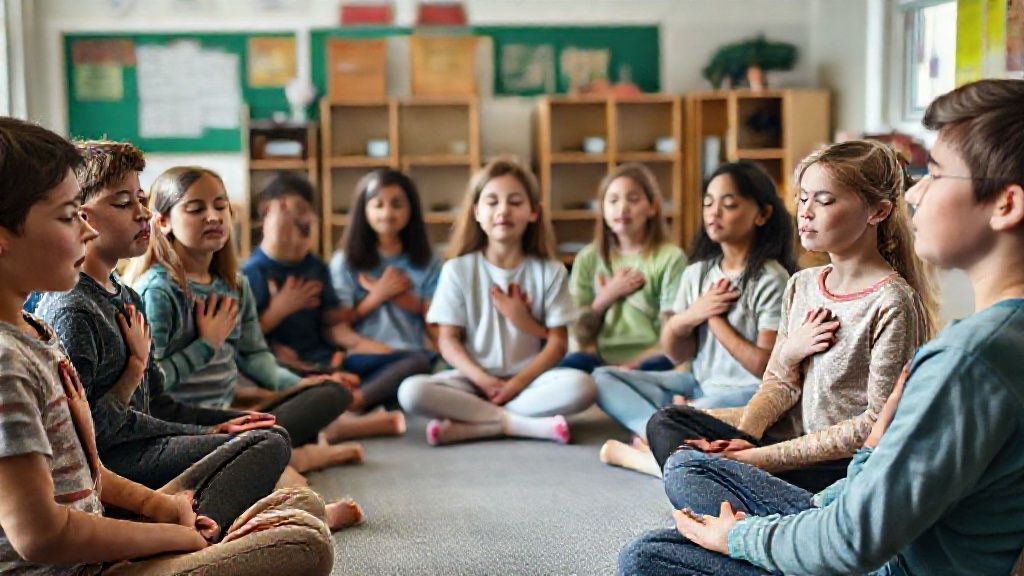
اليقظة الذهنية للمرحلة المتوسطة: دليل عملي لطلاب أكثر هدوءًا وتركيزًا

The middle school years represent one of the most challenging transitions in a young person’s life. Between escalating academic demands, complex social dynamics, hormonal changes, and constant digital stimulation, today’s middle schoolers face unprecedented levels of stress and anxiety. Many educators and parents watch helplessly as previously engaged students become overwhelmed, distracted, and emotionally volatile.
The good news? There’s a powerful, evidence-based solution that’s gaining traction in educational settings worldwide: mindfulness. Far from being just another educational trend, mindfulness offers practical, accessible tools that can help middle school students manage stress, improve focus, and build the emotional resilience needed to navigate these crucial years successfully.
Why Mindfulness Is a Game-Changer for the Middle School Brain
The adolescent brain undergoes remarkable development between ages 11-14, making it particularly receptive to mindfulness practices. During this period, the prefrontal cortex—responsible for decision-making, emotional regulation, and focus—is still maturing, while the amygdala—the brain’s emotional center—is highly active. This neurological imbalance explains why middle schoolers often experience intense emotions and impulsive behaviors.
Scientific research demonstrates that regular mindfulness practice can:
– Enhance attention and concentration by strengthening neural pathways associated with focus
– Reduce anxiety and stress by calming the amygdala’s reactivity
– Improve emotional regulation by creating space between stimulus and response
– Develop empathy and social awareness through increased self-awareness
– Boost academic performance by improving working memory and cognitive flexibility
For students struggling with anxiety, incorporating guided meditations for anxiety and depression can provide structured support during particularly challenging moments. The neurological benefits are measurable and profound, making mindfulness not just a nice-to-have addition but an essential component of middle school development.
5 Simple Mindfulness Activities to Start Today
The most effective mindfulness practices for middle schoolers are brief, engaging, and practical. Here are five exercises that resonate well with this age group and can be easily implemented in classrooms or at home.
The 1-Minute Breathing Reset
This ultra-short practice is perfect for those moments when stress begins to escalate—before a test, after a social conflict, or during homework frustration.
How to practice:
1. Sit comfortably with both feet on the floor
2. Close your eyes or soften your gaze
3. Place one hand on your belly
4. Breathe in slowly through your nose for 4 seconds
5. Hold your breath for 2 seconds
6. Exhale slowly through your mouth for 6 seconds
7. Repeat 3-5 times
This practice activates the parasympathetic nervous system, quickly reducing the physiological symptoms of stress. For a more structured approach, try our one-minute breathing exercise that provides guided instruction.
The 5 Senses Grounding Exercise
When students feel overwhelmed by anxiety or racing thoughts, this exercise helps bring their attention back to the present moment through sensory awareness.
How to practice:
1. Pause wherever you are and take one deep breath
2. Notice 5 things you can see around you
3. Notice 4 things you can touch or feel
4. Notice 3 things you can hear
5. Notice 2 things you can smell
6. Notice 1 thing you can taste
This technique is remarkably effective for interrupting anxious thought patterns. To explore this practice further, we offer a dedicated practice the 5 senses mindfulness exercise with variations for different settings.
A Quick Body Scan for Tension Release
Middle schoolers often carry physical tension without realizing it—clenched jaws during tests, tight shoulders from backpack weight, or stomach knots from social anxiety.
How to practice:
1. Sit or lie down comfortably
2. Close your eyes and bring attention to your feet
3. Slowly move your awareness up through your body—ankles, calves, knees, thighs
4. Notice any areas of tension without judgment
5. As you exhale, imagine releasing tension from each area
6. Continue through torso, hands, arms, shoulders, neck, and face
7. Take a final moment to notice your whole body
This practice develops body awareness and helps students recognize early signs of stress. For a guided version perfect for classroom use, download our 5-minute body scan script (PDF).

Guided Meditations Tailored for Tweens and Teens
While some students thrive with silent practice, many middle schoolers benefit significantly from guided meditations that provide structure and direction. The key is finding content that resonates with their developmental stage and interests.
Short Meditations for a Busy Schedule
Consistency matters far more than duration when establishing a mindfulness practice. Even 60 seconds of intentional breathing can create positive neurological changes over time.
Benefits of short practices:
– Easier to integrate into packed school schedules
– Less intimidating for beginners
– Builds the habit of pausing throughout the day
– Provides quick stress relief during challenging moments
For students new to meditation, we recommend starting with our تأمل موجه لمدة 5 دقائق that introduces basic concepts in an accessible format. Those ready for slightly longer practice might prefer our للتهدئة لمدة 10 دقائق that allows for deeper relaxation.
Meditations for Specific Challenges
Different situations call for different mindfulness approaches. Tailoring practices to specific needs increases their relevance and effectiveness for middle schoolers.
For Test Anxiety:
Academic pressure peaks during middle school, with standardized tests and increased homework loads. Mindfulness can help students approach tests with greater calm and focus. A short meditation for anxiety practiced regularly in the weeks leading up to exams can significantly reduce test-related stress.
For Better Sleep:
Many middle schoolers struggle with sleep due to hormonal changes, screen time, and overstimulation. Quality sleep is essential for learning, memory consolidation, and emotional regulation. Incorporating a تأمل مخصص للنوم قبل النوم into the evening routine can signal to the brain that it’s time to wind down and promote more restful sleep.
Implementing Mindfulness in School and at Home
Successful mindfulness integration requires support from both educators and parents. Here’s how to create a mindful environment in both settings.
For Educators:
– Start faculty meetings with one minute of mindful breathing
– Incorporate 2-3 minute mindfulness breaks between lessons
– Create a “mindful corner” in the classroom where students can self-regulate
– Weave mindfulness into existing curriculum (e.g., mindful reading or writing)
– Consider formal تدريب اليقظة الذهنية للمعلمين to deepen your practice and teaching skills
For Parents:
– Model mindfulness by practicing yourself
– Establish tech-free mindful moments during family meals
– Use car rides as opportunities for mindful listening
– Create a family meditation routine (even 2 minutes counts)
– Normalize emotional awareness by naming feelings without judgment
– Incorporate أنشطة اليقظة الذهنية الممتعة للمجموعات during family time

Overcoming Common Challenges and Objections
It’s normal to encounter resistance when introducing mindfulness to middle schoolers. Here’s how to address common concerns:
“This is weird/awkward”:
Acknowledge the discomfort! Explain that feeling strange is normal when trying something new. Use humor and keep the tone light. Start with very short practices and gradually increase duration as comfort grows.
“I can’t sit still”:
This is especially common with students who have ADHD or high energy levels. Offer alternatives like walking meditation, mindful movement, or mindful drawing. Emphasize that mindfulness isn’t about stopping thoughts but noticing them.
“It doesn’t work”:
Explore what “working” means to them. Mindfulness isn’t a magic eraser for difficult emotions but a tool for relating to them differently. Share that benefits often accumulate gradually rather than appearing immediately.
“I don’t have time”:
Highlight how mindfulness can actually save time by improving focus and efficiency. Start with “micro-practices” that take less than 60 seconds—these can be done between classes or during transitions.
الأسئلة الشائعة (FAQ)
Q: What is the simplest way to explain mindfulness to a middle schooler?
A: Explain it as “paying attention to what’s happening right now, on purpose and without judgment.” You might add, “It’s like using a remote control to choose what channel your brain is watching, instead of letting it flip channels randomly.”
Q: How long should a mindfulness session be for this age group?
A: Start very short! Even 1-5 minutes is effective. Consistency is more important than duration. As students become more comfortable, sessions can gradually extend to 10-15 minutes, but brief practices remain valuable throughout the day.
Q: Are there good mindfulness apps for kids and teens?
A: Yes, many apps offer content specifically designed for younger audiences with age-appropriate language and shorter sessions. For detailed recommendations, check out our review of the best mindfulness apps for kids that evaluates options based on safety, effectiveness, and engagement.
Q: Can mindfulness help with ADHD?
A: Mindfulness can be a valuable tool for improving focus and emotional regulation for students with ADHD. While it doesn’t replace other interventions, research shows it can enhance attention control and reduce impulsivity. To learn specific strategies, explore mindfulness strategies for ADHD in our dedicated resource.
Start Small, Start Today
The middle school years present unique challenges, but they also offer a remarkable opportunity to equip young people with skills that will serve them throughout their lives. Mindfulness isn’t about achieving perfect calm or emptying the mind—it’s about learning to navigate the inevitable ups and downs with greater awareness and resilience.
The most effective approach is to start small and be consistent. Choose just one activity from this guide—perhaps the 1-Minute Breathing Reset or the 5 Senses Grounding Exercise—and introduce it to your student or classroom this week. The cumulative effect of these small practices can create meaningful change over time.
As you explore mindfulness with the middle schoolers in your life, remember that you’re not just teaching techniques—you’re helping them develop a healthier relationship with their own minds. To deepen your understanding of these practices, Learn more about what guided meditation is and how it works in our comprehensive guide.